At a glance
A current named for Christmas
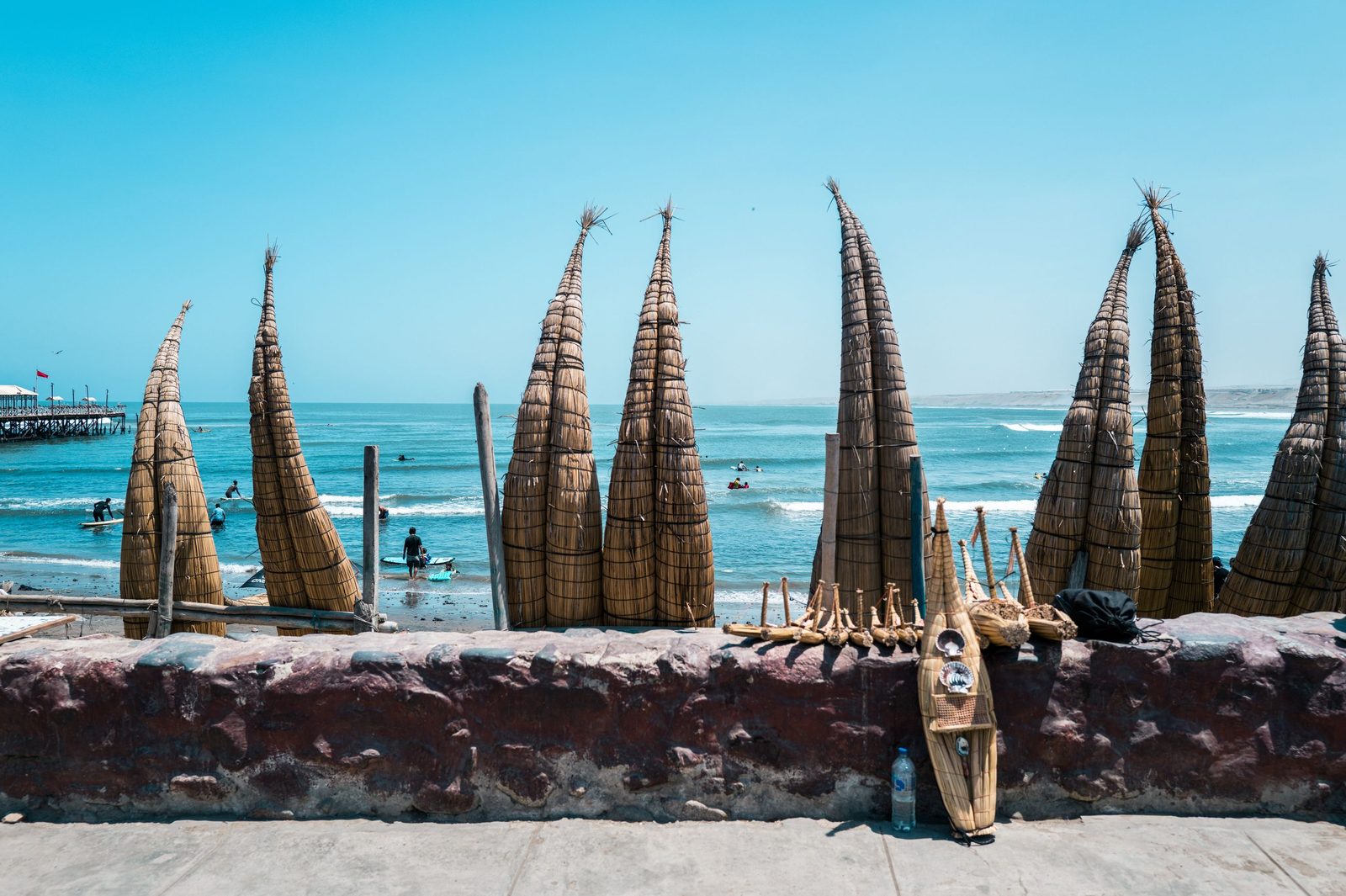
The fishermen of northern Peru knew it first. In some years, around Christmas, the cold green water off their coast turned warm and blue, the fish vanished, and rain fell on a desert that might not see a shower for years. Spanish colonists described such years from the 1500s. Sailors around Paita noticed a warm current flowing south against the usual drift soon after Christmas and called it the current of El Niño, the Child Jesus.
Science arrived in 1891, when Luis Carranza of the Lima Geographical Society described a counter-current running from north to south between the ports of Paita and Pacasmayo, and linked its warm water to the floods of April and May. In 1895 Federico Alfonso Pezet told the Sixth International Geographical Congress that the warm current brought the rains to Peru's coastal deserts. Camilo Carrillo's article La corriente del Niño carried the name into the scientific literature. For decades, though, El Niño was treated as a local quirk of Peru and Ecuador.
A see-saw in the air
The other half of the story began with famine. Monsoon failures in 1877 and 1899 brought famines that killed millions in India (see The Great El Niño of 1877-78). In 1904 the British appointed a Cambridge mathematician, Gilbert Walker, as director-general of observatories in India. He had no training in meteorology but brilliant statistical skills, and a nickname, Boomerang Walker, earned from his studies of how boomerangs fly.
Others had glimpsed the pattern. In 1897 Hugo Hildebrandsson noticed that pressure in widely separated places varied in step, and in 1902 Norman and William Lockyer confirmed a see-saw between South America and Indonesia. Walker turned the hint into a system. In 1923 and 1924 he named it the Southern Oscillation: when pressure is high over the eastern Pacific it tends to be low over the Indian Ocean and Indonesia, and the reverse (see Tahiti, Darwin and the See-Saw of the Pacific). But he never linked it to the warm current off Peru.
Bjerknes joins the dots
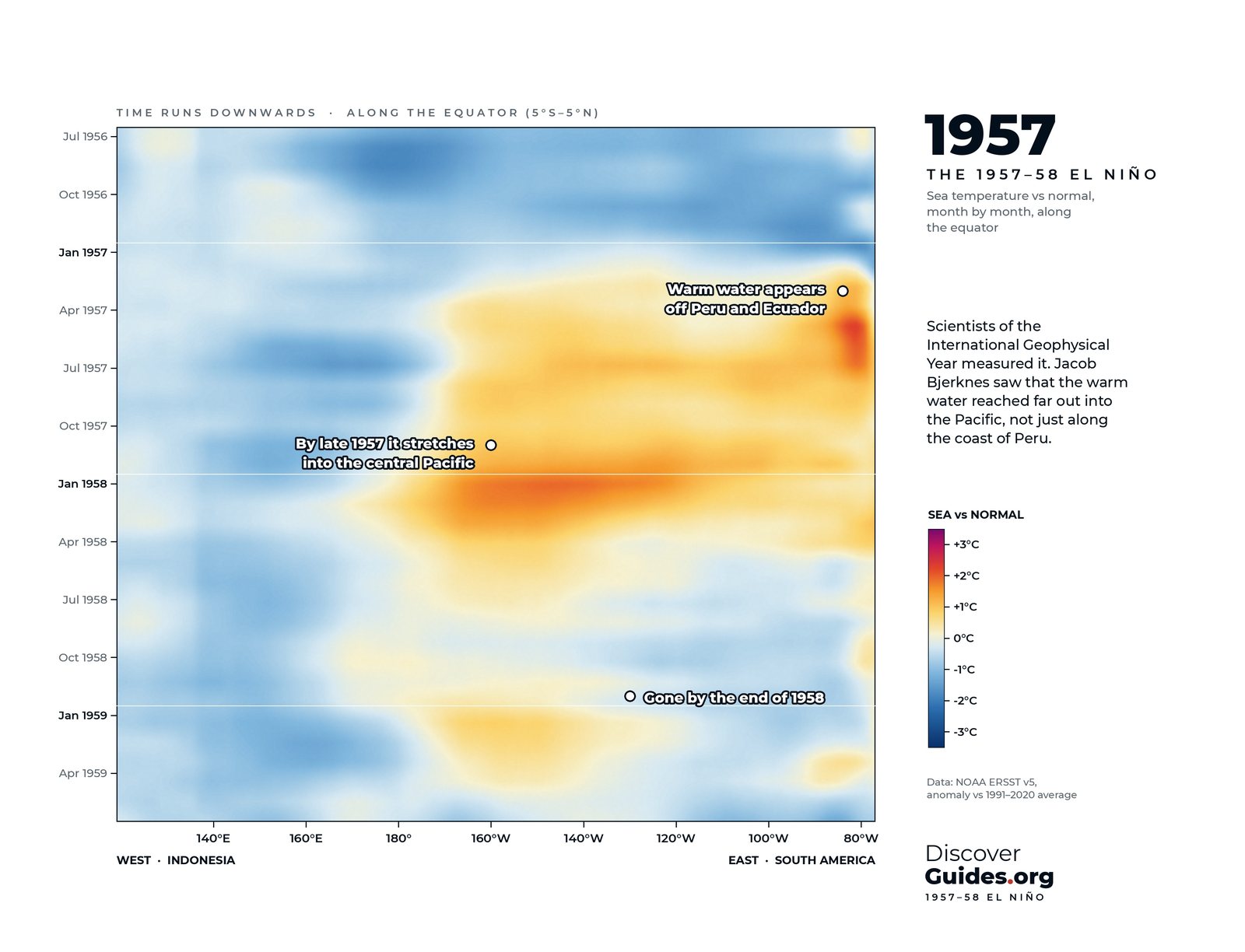
The connection came from a Norwegian. Jacob Bjerknes had helped build the theory of mid-latitude storms before moving to the University of California, Los Angeles. The El Niño of 1957-58 coincided with the International Geophysical Year, and the measurements made then showed him that the warm water stretched far out into the central Pacific, not just along the coast of Peru.
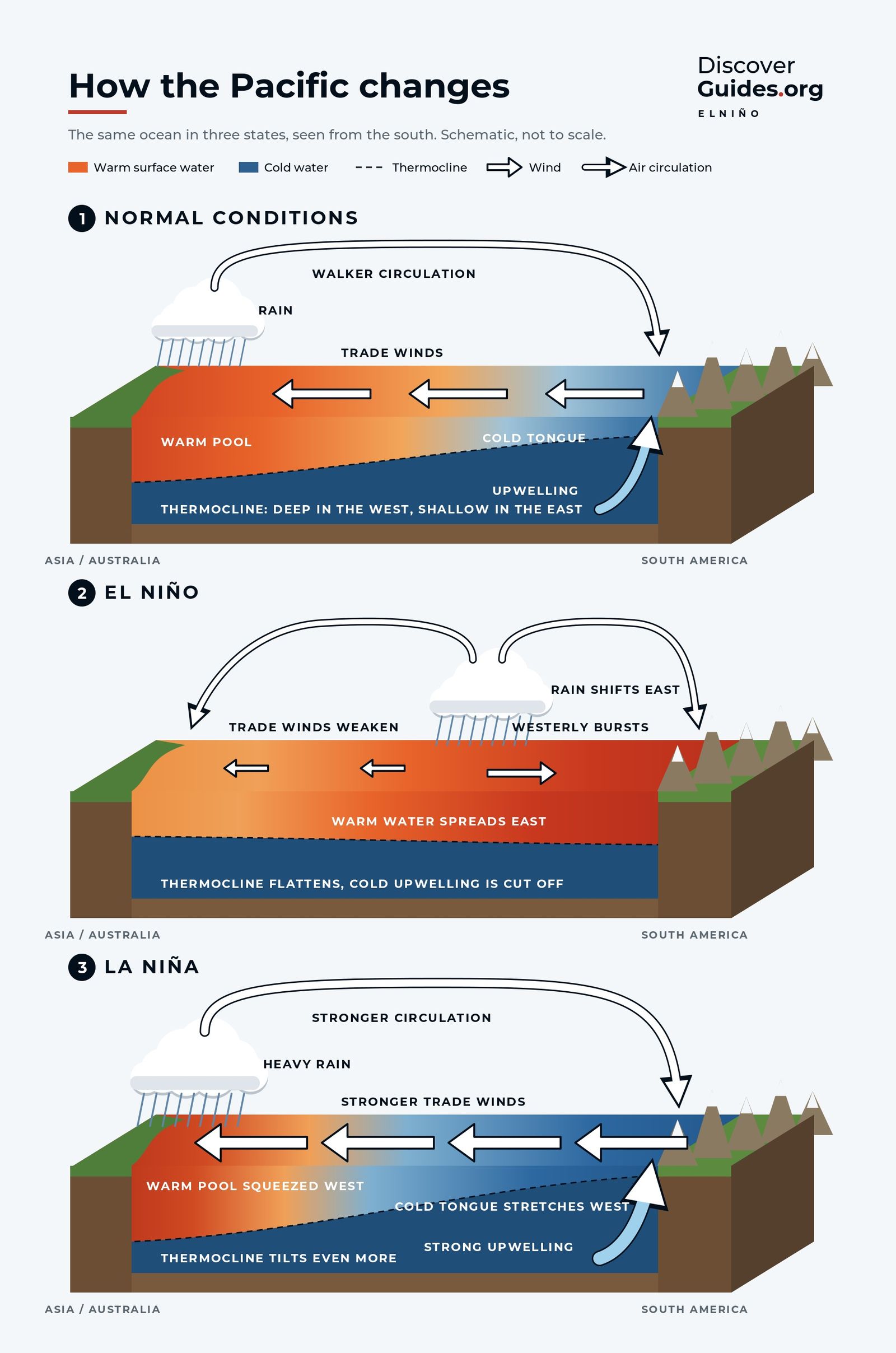
In 1966 and then in 1969 Bjerknes set out the idea that still anchors the science. The east-west difference in ocean temperature drives an east-west circulation of air, which he named the Walker circulation in honour of the man who had found its pressure signature, and the winds in turn maintain the temperature difference. El Niño off Peru and the low phase of Walker's Southern Oscillation were two faces of one ocean-atmosphere system, today called ENSO (see The Bjerknes Feedback).
The ocean's answer
Bjerknes explained how the system held together, but not how an event began. In 1975 Klaus Wyrtki of the University of Hawaii used tide gauges on Pacific islands to show that strong trade winds pile water up in the west, and that when they relax the stored warm water surges east along the equator as a wave (see Kelvin Waves Explained). Wyrtki and colleagues made the first El Niño forecast in the mid-1970s, but the warming they expected did not come. Seven years later the giant of 1982-83 caught scientists off guard, and the TOGA programme that began in 1985 built the buoys that watch the Pacific today.
- 1500sColonial reports
Spanish colonists describe years of warm water and rain on Peru's coast.
- 1891Carranza
The warm counter-current is reported to the Lima Geographical Society.
- 1904Walker
Gilbert Walker takes charge of meteorology in India.
- 1923-24Southern Oscillation
Walker names the Pacific pressure see-saw.
- 1957-58IGY
El Niño observed during the International Geophysical Year.
- 1969Bjerknes
The ocean-atmosphere link is published.
- 1975Wyrtki
The eastward surge of warm water is explained.
- 1985TOGA
A ten-year programme starts building the Pacific observing system.
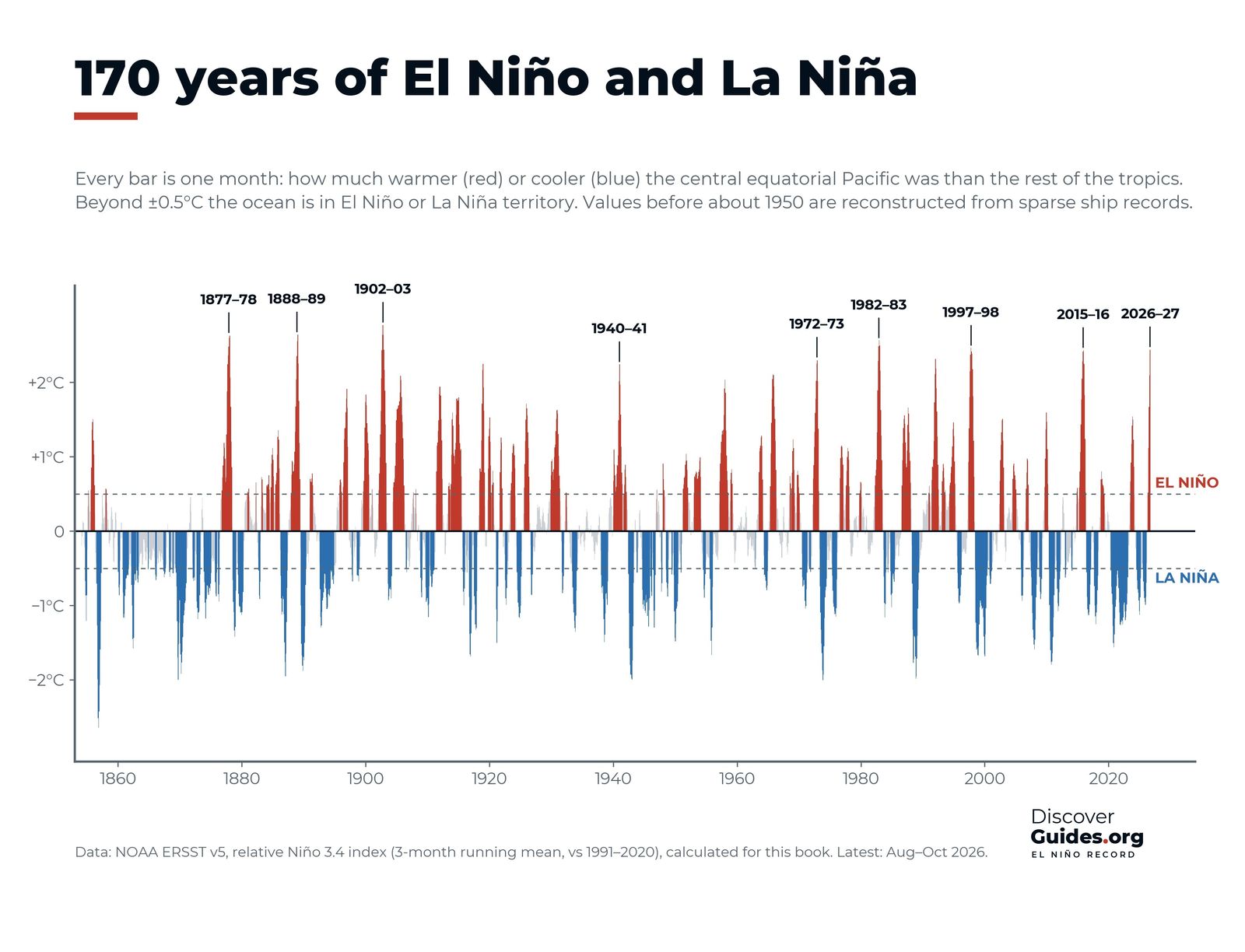
Today scientists can reconstruct the past too. NOAA has stitched ship logs, buoys and satellites into a sea surface temperature record reaching back to the mid-nineteenth century, shown at the top of this page. It shows that the giants are not new, and the slow upward drift beneath them.
Questions
Who discovered El Niño?
Peruvian fishermen named the warm Christmas current. Luis Carranza described it scientifically in 1891, Gilbert Walker found the related pressure see-saw in the 1920s, and Jacob Bjerknes showed in 1969 that they were one ocean-atmosphere system.
Why is it called El Niño?
Because the warm current tended to appear off Peru around Christmas, sailors named it after the Child Jesus, El Niño.
Who was Gilbert Walker?
A British mathematician who became director-general of observatories in India in 1904. Searching for a way to forecast the monsoon, he discovered and named the Southern Oscillation.
When was the first El Niño forecast?
Klaus Wyrtki and colleagues made the first forecast in the mid-1970s, though the warming did not arrive. In 1986 a model by Mark Cane and Stephen Zebiak made one of the first successful forecasts.