At a glance
A partnership that runs on sunlight
A reef-building coral is an animal, but it lives in partnership with microscopic algae inside its tissue. The algae photosynthesise and pass most of the food they make to the coral, which in return gives them shelter and nutrients. The algae also give corals most of their colour.
The partnership is finely tuned. Many corals already live within a degree or two of the highest temperatures they can stand, which is why a small rise, held for long enough, can break it.
The stakes are large. According to NOAA, coral reefs cover less than one percent of the ocean floor yet support about a quarter of all known marine species, and they protect coastlines, feed hundreds of millions of people and support fishing and tourism.
What heat does to a coral
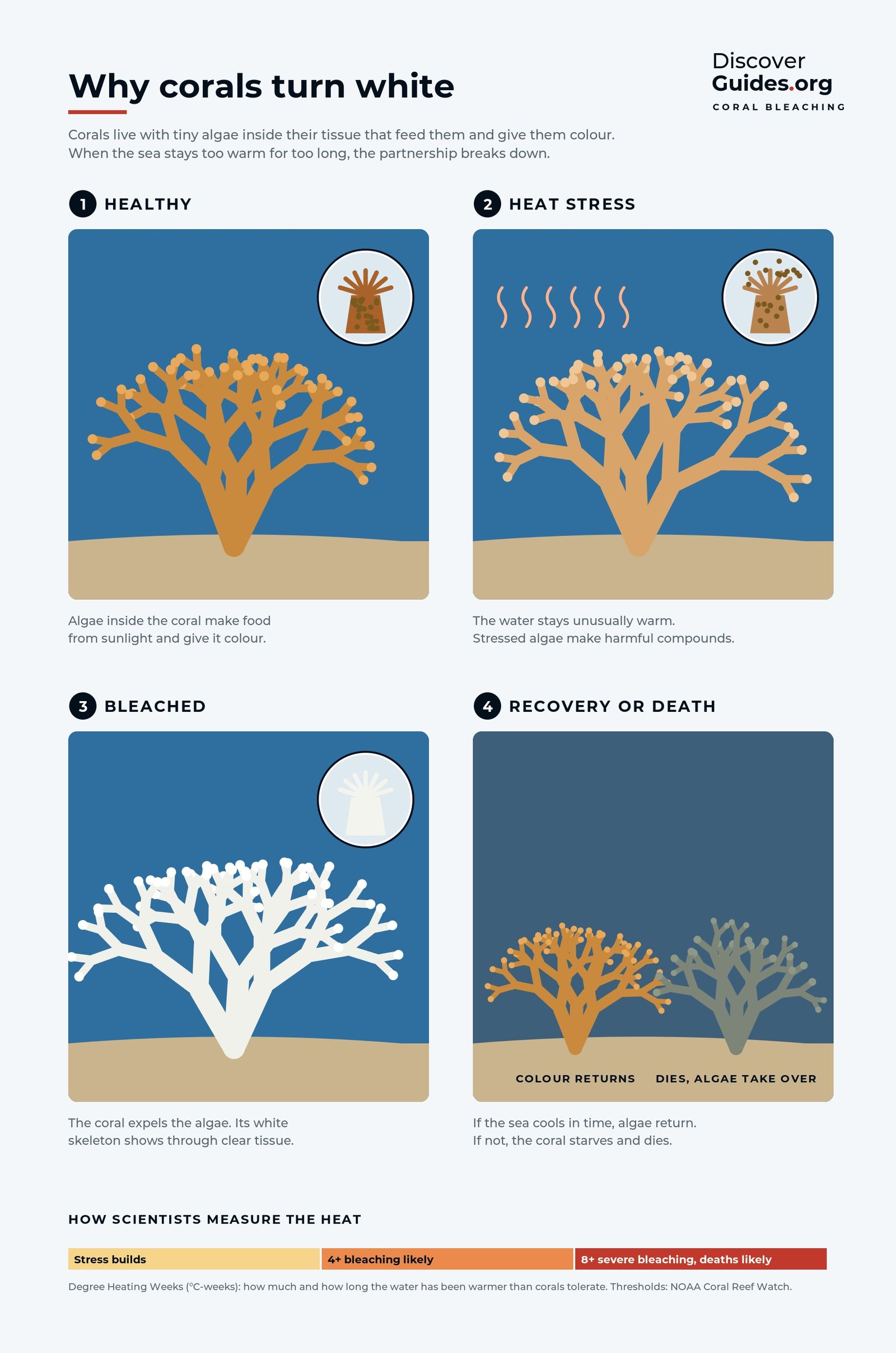
The graphic above shows the four stages. When the water stays unusually warm, the stressed algae start making harmful compounds instead of food. The coral expels them, and its white skeleton shows through its now-clear tissue: it has bleached. A bleached coral is not dead, but it is starving.
If the sea cools in time, the algae can return and the colour comes back over weeks to months. If the heat lasts, the coral starves or succumbs to disease, and seaweed takes over the dead skeleton. Even survivors grow and reproduce less for a time.
How scientists measure the heat
NOAA's Coral Reef Watch tracks reef heat stress from satellites using degree heating weeks. It adds up how far, and for how long, the water has been warmer than the usual warmest month of the year at each reef, over a rolling 12 weeks. The unit is °C-weeks: two weeks at 2°C over the threshold counts the same as four weeks at 1°C.
- Below 4 °C-weeks. Stress building; some bleaching possible.
- 4 °C-weeks or more. Significant bleaching likely.
- 8 °C-weeks or more. Severe, widespread bleaching and significant coral deaths likely.
Coral Reef Watch publishes its maps and outlooks openly at coralreefwatch.noaa.gov, and they are the best place to follow conditions on a particular reef.
Why El Niño and bleaching go together
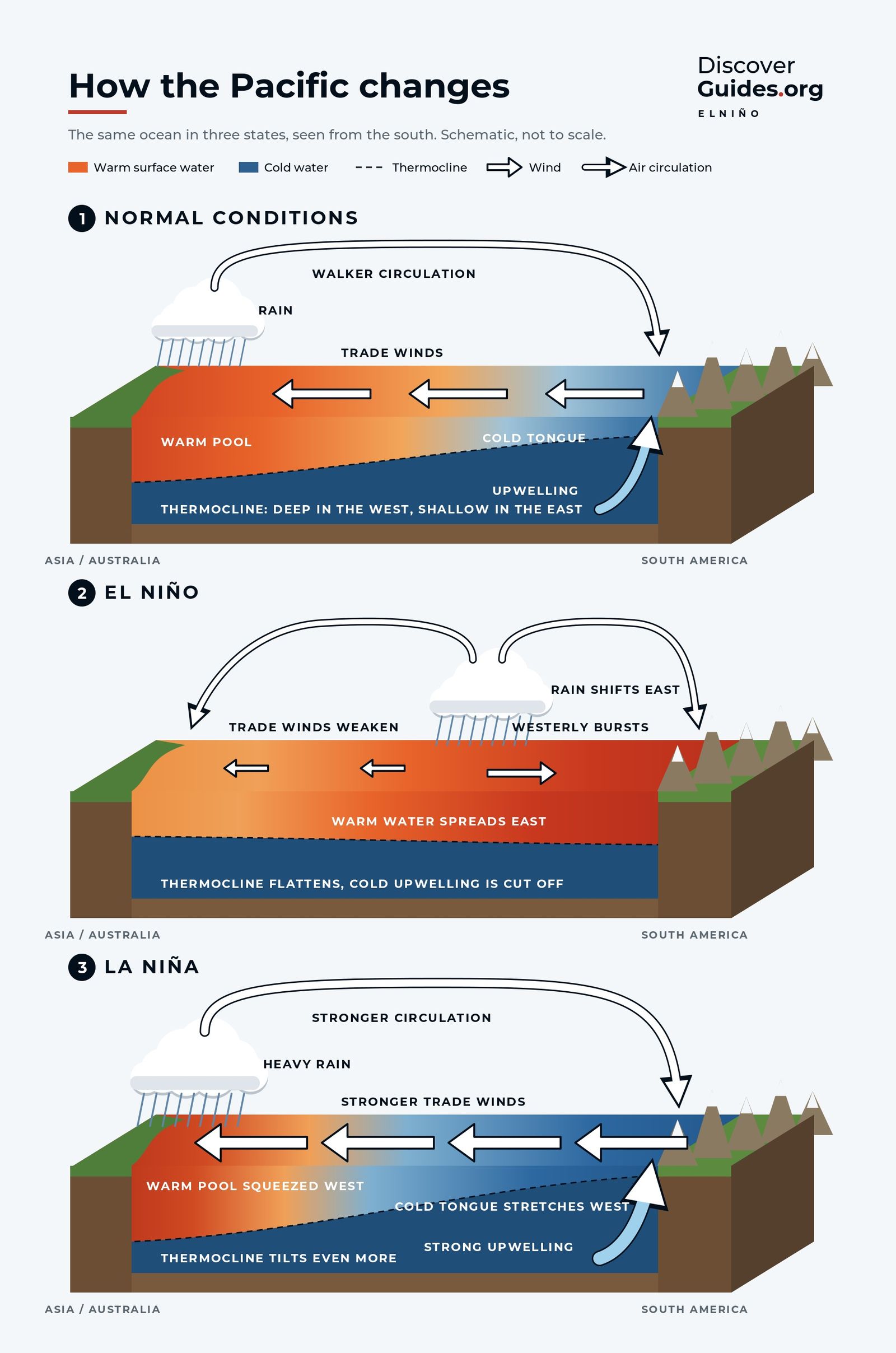
El Niño spreads warm water east across the equatorial Pacific, straight over reefs that normally sit in cooler water, such as those of the Galápagos, where most of the coral died in 1982-83. It also changes cloud and wind patterns, bringing calm, clear, sunny weather to some reef regions, which lets the sea surface heat up even more.
Its reach goes further. El Niño releases heat from the Pacific into the atmosphere and lifts global temperature for months afterwards, as explained in El Niño and global temperature. That extra warmth reaches reefs in the Indian Ocean, the Caribbean and Australia, often in the season after the El Niño peaks.
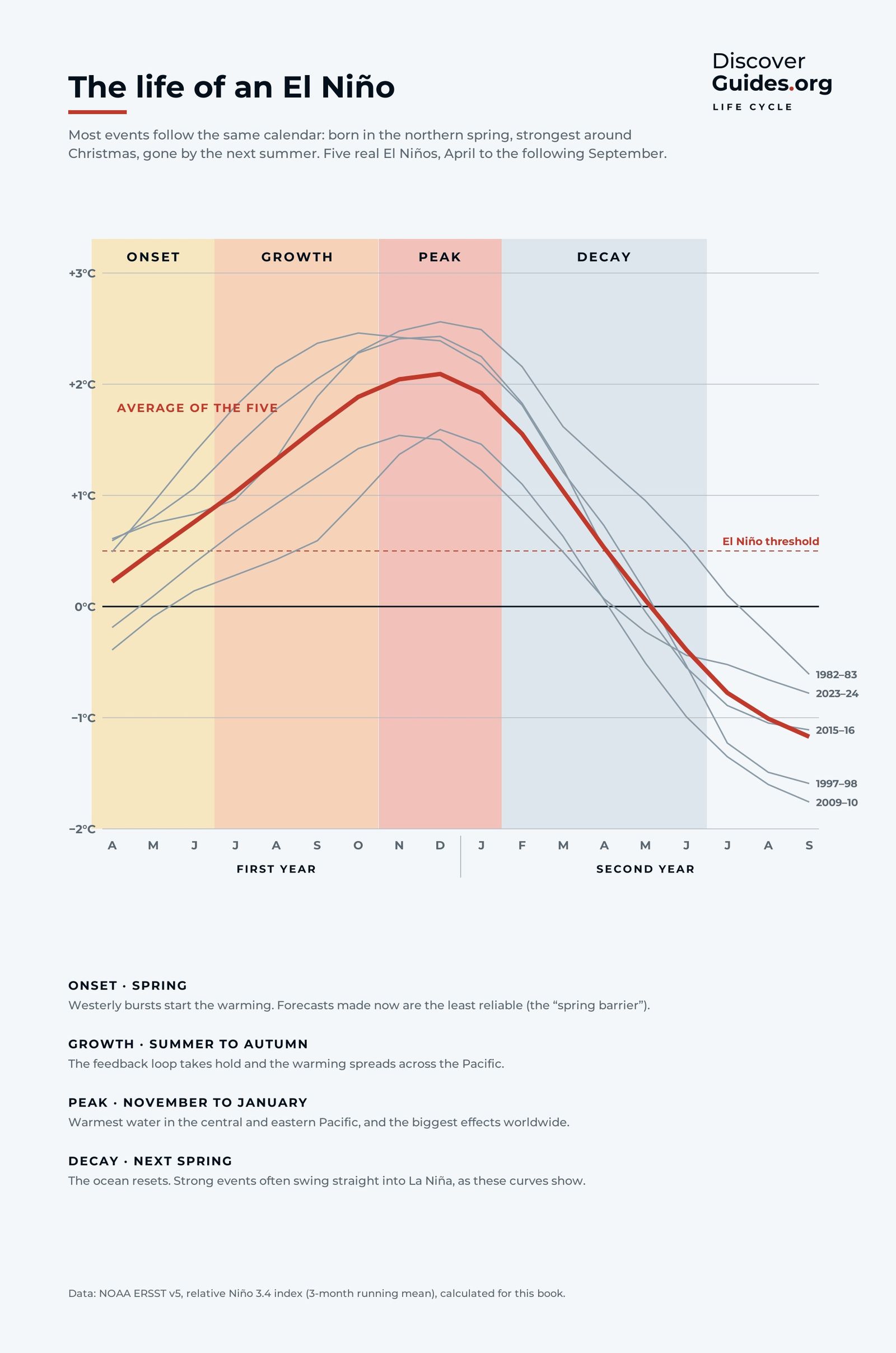
Four global bleaching events
- 1998. The first global event, during the 1997-98 El Niño, with heavy losses in the Indian Ocean (see El Niño 1997-98).
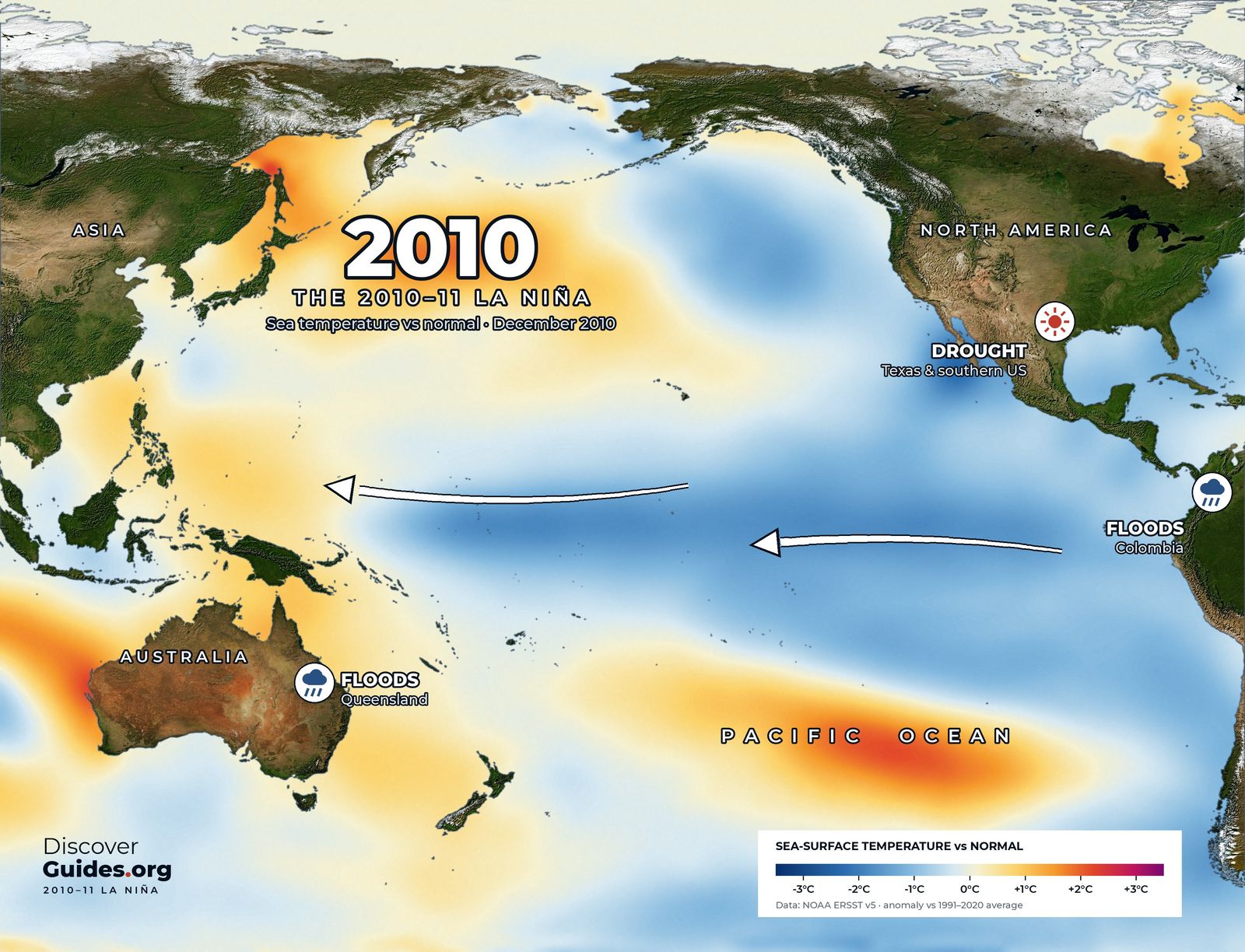
- 2010. The second, during and after the El Niño of 2009-10.
- 2014-2017. The third and, at the time, the longest, spanning the 2015-16 El Niño and the Great Barrier Reef's worst bleaching to that point (see El Niño 2015-16).
- 2023-2025. The fourth, confirmed by NOAA in April 2024 during the 2023-24 El Niño. Bleaching-level heat reached 84% of the world's reef area, and mass bleaching was documented in at least 83 countries and territories (see El Niño 2023-24).
NOAA notes that each global event since 1998 has coincided with a strong El Niño and each has been more widespread and severe than the last. The reason is the rising baseline: sea temperatures today are higher than 25 to 30 years ago, so each El Niño starts from a warmer ocean and pushes more reefs past the threshold.
Not every reef bleaches the same
Even in a global event, bleaching is patchy. Deeper corals often fare better than those in the shallows, some species tolerate heat better than others, and reefs swept by cooler currents or shaded by cloud at the right moment can escape. After the 2016 bleaching on the Great Barrier Reef, the Australian Institute of Marine Science found heavy losses in the north and little or no mortality further south. NOAA says scientists are still studying why some reefs avoided bleaching during the fourth global event despite high temperatures.
What 2026-27 could mean for reefs
NOAA judged that the fourth global event likely ended in mid-2025, confirming it only after no widespread bleaching was found in the southern summer of December 2025 to February 2026. At the same time NOAA warned that the coming El Niño could bring widespread bleaching back, and its scientists say reefs will now bleach on a near-annual basis.
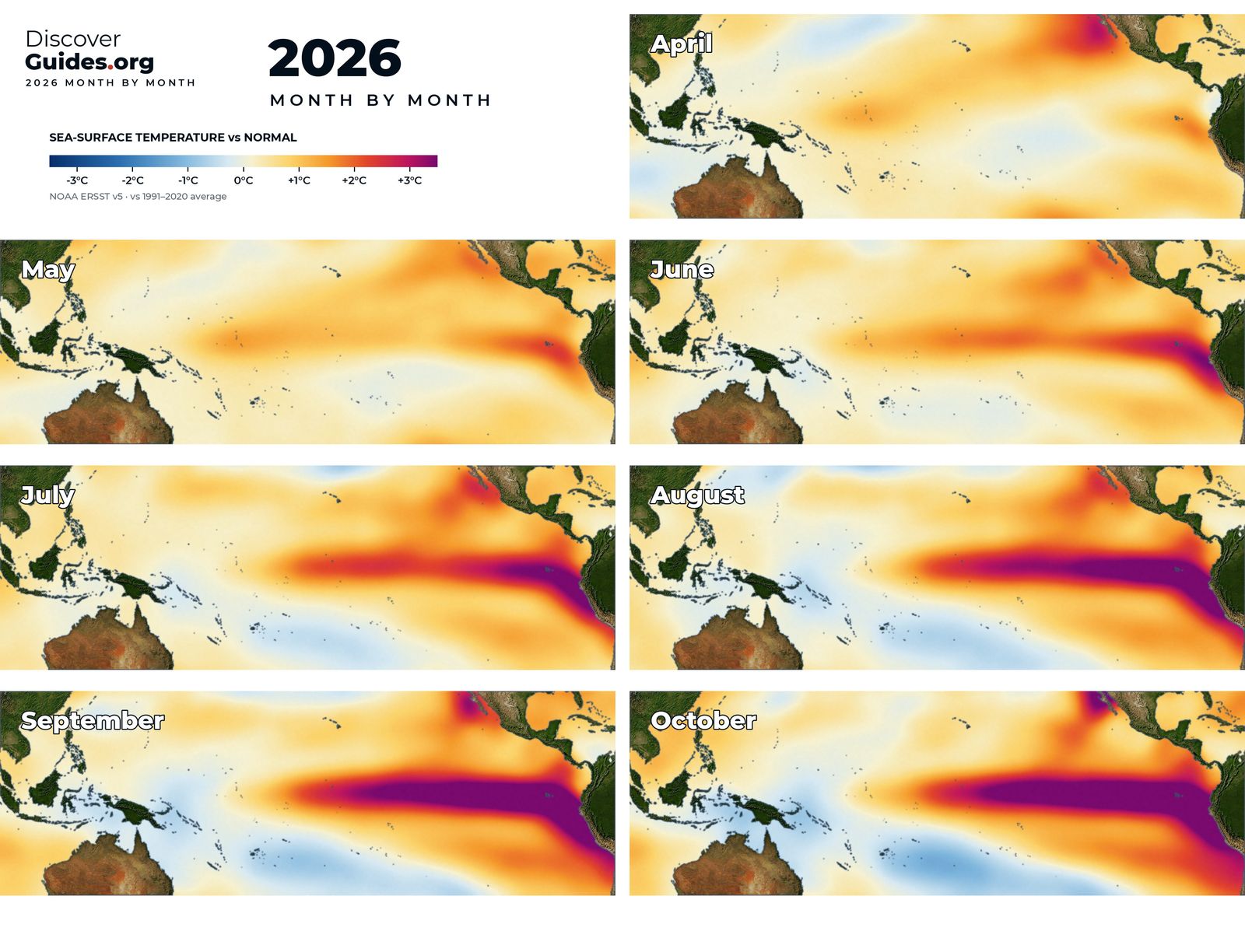
As of NOAA's October 2026 ENSO update, sea surface temperatures exceeded +4°C (7.2°F) above normal in parts of the eastern equatorial Pacific, and a strong to very strong El Niño was likely through January to March 2027, the season when southern hemisphere reefs are warmest. Outlooks can change, and whether a fifth global event follows will depend on how heat builds reef by reef. Coral Reef Watch is the place to follow it.
The book Discover El Niño has a full chapter on life in hot water, from coral and plankton to seabirds and the Galápagos.
To see the places in this story for yourself, our guides Discover Australia: The Great Barrier Reef and Discover Indonesia: The Coral Triangle take you there.
Questions
Why does El Niño cause coral bleaching?
El Niño spreads unusually warm water across the tropical Pacific and lifts global temperatures for months. When the water stays too warm for too long, corals expel the algae that feed them and turn white.
Can bleached coral recover?
Yes, if the water cools in time. The algae can return over weeks to months. If the heat lasts, the coral starves or dies of disease and seaweed overgrows it.
What are degree heating weeks?
A measure of accumulated heat stress used by NOAA Coral Reef Watch. From about 4 °C-weeks significant bleaching is likely; from about 8 °C-weeks severe bleaching and deaths are likely.
How many global coral bleaching events have there been?
Four: 1998, 2010, 2014-2017 and 2023-2025. Each coincided with a strong El Niño.
Will 2026-27 cause another global bleaching event?
It is not yet known. NOAA has warned that the 2026-27 El Niño could bring widespread bleaching back, and NOAA Coral Reef Watch publishes live outlooks for reefs worldwide.