At a glance
A fast start
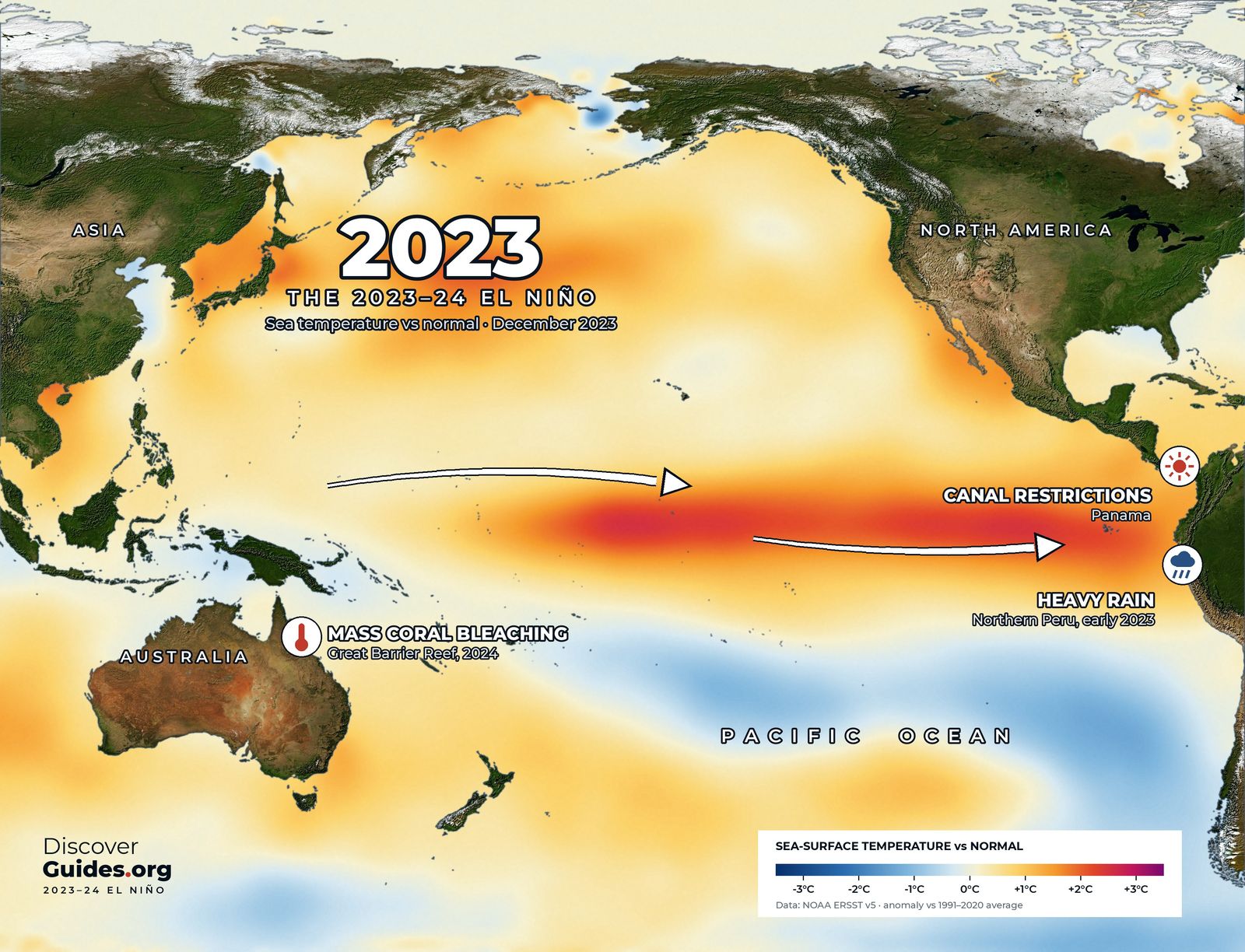
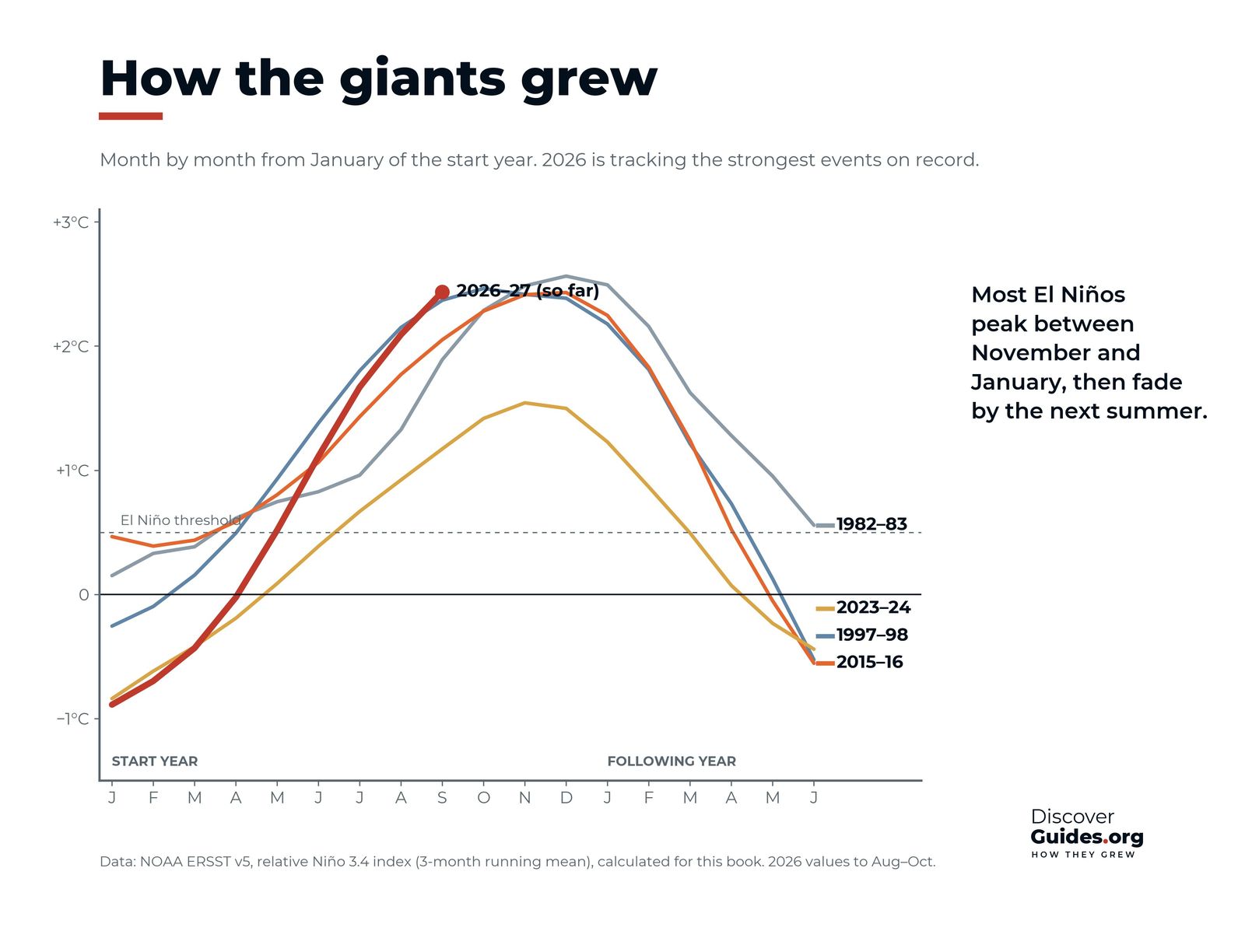
The Pacific swung out of three years of La Niña in early 2023. Off Peru the sea warmed first: a coastal El Niño brought heavy rain to the normally dry north of the country in the first months of the year, marked on the map above. NOAA declared El Niño conditions in June 2023. The event grew through the northern summer and autumn, peaked between November 2023 and January 2024, and faded through the first half of 2024.
Strong or moderate? It depends how you measure
On NOAA's traditional Oceanic Niño Index, 2023-24 peaked at about +2.0°C (3.6°F), enough for the informal label of a very strong event. On the relative index NOAA adopted in 2026 it peaked at only about +1.4°C.
The difference comes from the rest of the tropics. In 2023 oceans almost everywhere were unusually warm, so the central Pacific stood out less against its surroundings than the old index suggested. That is exactly the effect the relative index was designed to remove. More on how the giants compare is in the strongest El Niños, ranked.
The hottest years on record
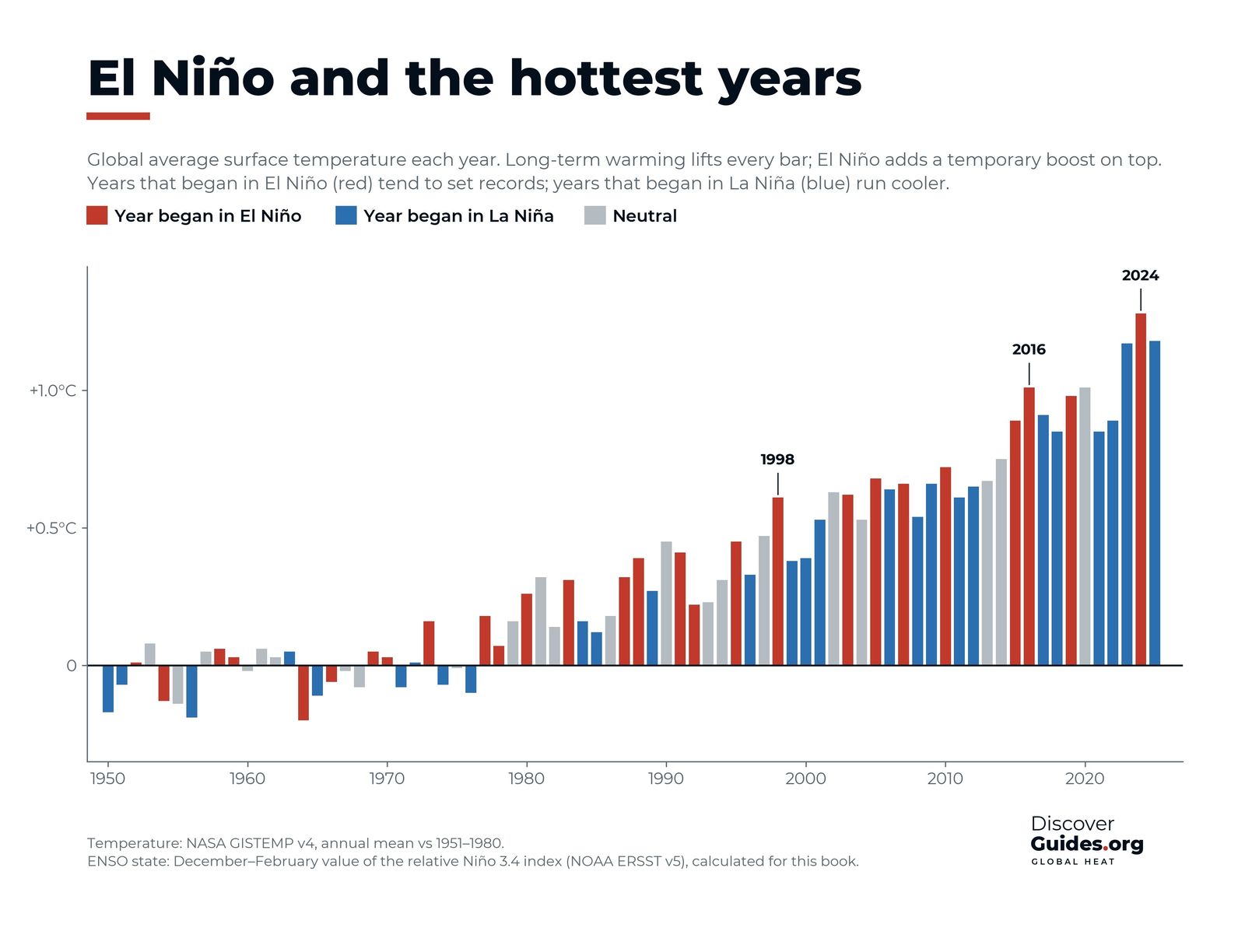
Global temperature responds to El Niño with a lag of a few months, as heat stored in the Pacific escapes into the atmosphere. 2023 set a new global record, about 1.48°C above the pre-industrial average according to the EU's Copernicus Climate Change Service. 2024, the year after the peak, went higher still. The World Meteorological Organization, combining six international datasets, put it at about 1.55°C (2.8°F) above the 1850-1900 average, with a margin of about 0.13°C, and confirmed it as the warmest year on record.
That does not mean the Paris Agreement's 1.5°C limit has been crossed: the limit refers to warming averaged over decades, not a single year. And El Niño explains only part of the heat. The steady rise underneath comes from greenhouse gases, with El Niño adding a temporary boost on top, as El Niño and global temperature explains.
More than El Niño
2023 was strange in ways El Niño alone cannot explain. Record warmth spread across the North Atlantic months before El Niño was well under way, and Antarctic sea ice fell to record lows. Scientists are still untangling the contributions of greenhouse gases, the natural swing of El Niño, changes in shipping fuel that reduced reflective pollution over the oceans, and the 2022 Hunga Tonga eruption. What is clear is that El Niño arrived on top of an ocean that was already exceptionally warm.
Too little water, and too much
- Panama Canal. Drought, worsened by El Niño, drained Gatún Lake, which feeds the canal's locks. From July 2023 the canal cut daily ship crossings and limited how deeply ships could load, its first climate-related capacity limit since the expanded locks opened in 2016.
- The Amazon. Severe drought in 2023, with the Rio Negro at Manaus falling to its lowest level on record in October. A very warm tropical Atlantic added to El Niño's effect.
- Southern Africa. Drought in early 2024 led Zambia, Zimbabwe and Malawi to declare national disasters as harvests failed.
- Northern Peru. Heavy rain and flooding on the coast in early 2023, during the coastal El Niño.
- California. Atmospheric-river storms in February 2024 dropped more than half a normal year's rain on parts of Los Angeles in a few days.
The fourth global coral bleaching event
On 15 April 2024 NOAA confirmed the fourth global coral bleaching event on record. It ran from early 2023 to mid-2025, and bleaching-level heat stress reached 84% of the world's coral reef area, with mass bleaching documented in at least 83 countries and territories. The Great Barrier Reef bleached again in early 2024. NOAA notes that each global event since 1998 has coincided with a strong El Niño, and each has been more widespread than the last.
Storms that broke the pattern
El Niño usually suppresses Atlantic hurricanes, yet 2023 was an above-normal Atlantic season, because record ocean warmth in the Atlantic outweighed El Niño's wind shear. In the eastern Pacific, Hurricane Otis intensified from a tropical storm to a Category 5 hurricane in about a day and struck Acapulco in October 2023. The general rules are in El Niño, hurricanes and typhoons.
The end of the event
By the middle of 2024 the El Niño was over, and the Pacific drifted toward La Niña conditions late in the year. Global temperatures stayed near record levels well into 2025, another sign of how much heat the event had released and how high the background has risen. The contrast with the cold phase is covered in El Niño vs La Niña.
From 2023-24 to 2026-27
2023-24 showed that a strong, not record-breaking El Niño can still break the planet's records when the background is warm enough. The 2026-27 event is far stronger in the Pacific: as of NOAA's October 2026 update, forecasters gave an 83% chance that October to December would pass +2.5°C on the relative index, beyond any event since 1950. Outlooks can change. The book Discover El Niño explains what that could mean.
Questions
Was 2023-24 a super El Niño?
On NOAA's traditional index it peaked at about +2.0°C, which is often called very strong or super. On the relative index NOAA now uses it peaked at about +1.4°C, because the rest of the tropics was also unusually warm.
Did El Niño cause 2024 to be the hottest year?
It contributed. El Niño added a temporary boost of heat on top of long-term warming from greenhouse gases, and global temperature typically peaks a few months after El Niño does.
How hot was 2024?
The WMO put 2024 at about 1.55°C above the 1850-1900 average, give or take about 0.13°C, the warmest year on record.
When did the 2023-24 El Niño start and end?
NOAA declared El Niño conditions in June 2023. The event peaked between November 2023 and January 2024 and faded during the first half of 2024.