At a glance
The world's biggest fishery
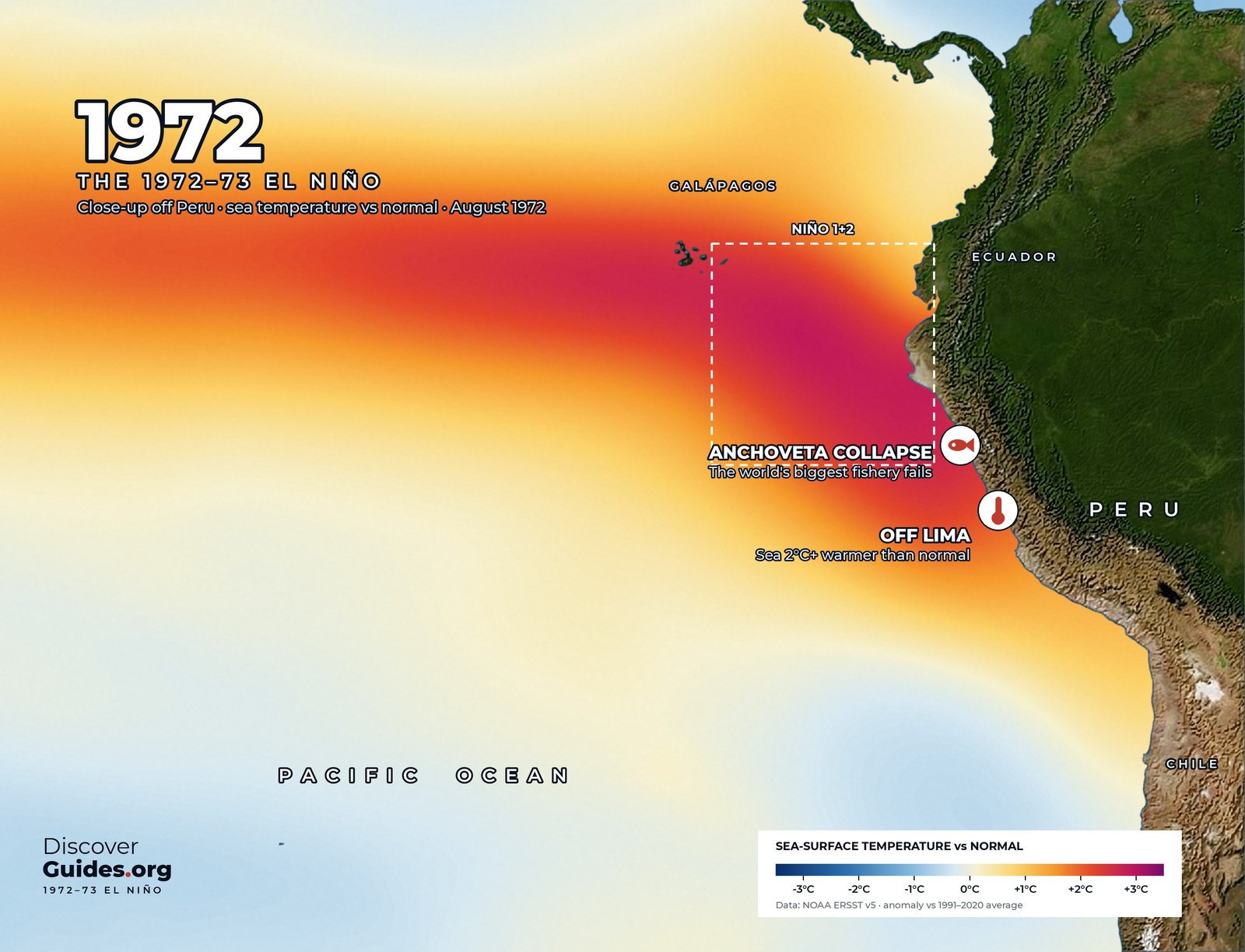
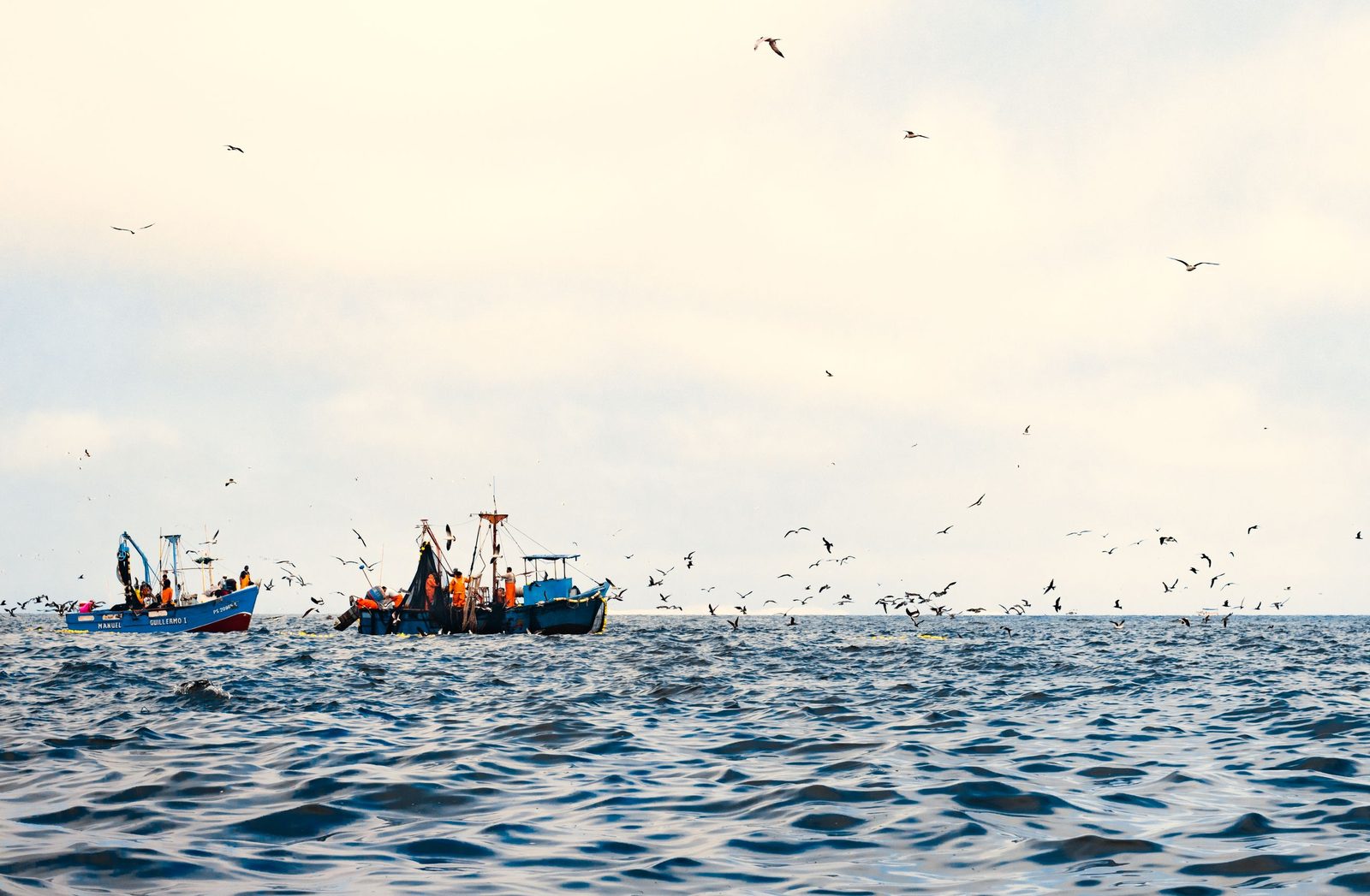
Off Peru, cold upwelling water feeds one of the richest seas on Earth (see Ocean Upwelling Explained). Its star is the Peruvian anchoveta, a small, fast-growing fish. According to NOAA's Michael McPhaden, Peru's catch topped 10 million tonnes a year in the late 1960s and early 1970s, roughly one fifth of the entire world catch. FAO records a peak of 13.1 million tonnes in 1970. Most of it was ground into fishmeal for animal feed.
How strong was 1972-73?
On NOAA's traditional Oceanic Niño Index the 1972-73 event peaked at +1.8 °C. On the newer relative index, which removes the warming of the whole tropical ocean, it reached +2.0 °C, putting it among the giants of the modern record (see How El Niño Is Measured). In the Atlantic it brought some of the strongest August-October wind shear over the Caribbean ever recorded: NOAA's review of 2015 found only two seasons with stronger shear, 1972 and 1986, both El Niño years.
The collapse
Warm water cut the nutrient supply, young fish failed to join the stock, and fishing pressure stayed high. By 1973 the catch had fallen to 1.7 million tonnes. FAO concluded that the El Niño was a primary cause of recruitment failure and stock decline, made worse by inadequate management.
| Year | Anchoveta catch | Context |
|---|---|---|
| 1970 | 13.1 million t | Record peak |
| 1973 | 1.7 million t | After the 1972-73 El Niño |
| 1984 | 94,000 t | Stock at historical low after 1982-83 |
| 1994 | 11.9 million t | Recovered |
The fishery did not bounce back quickly. The 1982-83 El Niño struck a stock that was already depleted and pushed it to its historical minimum: catches bottomed out at just 94,000 tonnes in 1984. Recovery took a decade, and by 1994 Peru was landing 11.9 million tonnes again (see El Niño 1982-83).
The guano birds
Peru's offshore islands hold vast colonies of seabirds known as aves guaneras, the guano birds: the guanay cormorant, the Peruvian booby and the Peruvian pelican. Their main food is anchoveta. A study presented to an FAO expert meeting in 1983 found that the three species numbered about 18 million birds in 1963. Warm-water years had already cut them to about 4.3 million by 1968.
The 1972-73 El Niño then cut a partial recovery of about 6.5 million birds to about 1.8 million. The guanay cormorant, the species most dependent on anchoveta, was hit hardest, with mortality of 77 to 80 per cent reported for 1972-73; by 1980-81 its population was only 16 per cent of its 1962-63 level. Boobies and pelicans recovered better by switching to other fish.

The cold years that followed
Like many strong El Niños, 1972-73 swung into La Niña. The La Niña of 1973-76 reached −2.0 °C on the official ONI in late 1973, the coldest of the strong La Niñas since 1950, and lasted three winters (see The Strongest La Niñas on Record).
The lesson of 1972-73 shaped how fisheries are managed in El Niño years. In September 2026 Peru's El Niño committee, ENFEN, expected anchovy to crowd close to the coast and deeper in the north-central region, while warm-water species such as yellowfin tuna and dolphinfish arrived off central Peru. For fishing fleets, a strong El Niño redraws the map of where the catch is.
Questions
What happened in the 1972-73 El Niño?
Warm water off Peru cut the nutrient supply to the anchoveta, and combined with heavy fishing the stock collapsed. The catch fell from a record 13.1 million tonnes in 1970 to 1.7 million tonnes in 1973.
How strong was the 1972-73 El Niño?
It peaked at +1.8 °C on NOAA's Oceanic Niño Index and +2.0 °C on the newer relative index, RONI.
Did El Niño alone destroy the anchoveta fishery?
No. FAO concluded El Niño was a primary cause of recruitment failure and stock decline, made worse by inadequate management and continued heavy fishing.
What came after the 1972-73 El Niño?
The La Niña of 1973-76, which reached −2.0 °C on the official ONI, the coldest of the strong La Niñas since 1950.