At a glance
Upwelling happens when the wind pushes surface water away and deeper water rises to take its place. That deep water is cold, but it carries something precious: nutrients such as nitrate and phosphate that have built up in the dark depths. In sunlit surface water they feed a bloom of life that supports some of the richest fisheries on the planet.
Why wind along a coast lifts water from below
In 1902 the Swedish scientist Vagn Walfrid Ekman worked out what happens beneath a wind-blown sea. The wind drags the surface layer, which drags the layer below, and so on downward. Each deeper layer moves more slowly and is deflected further by Earth's rotation, so the flow twists into a spiral with depth. NOAA notes that the motion fades out at about 100 metres.
Averaged over the whole layer, the water moves sideways to the wind, not straight along it. That is the secret behind coastal upwelling. NOAA notes that conditions are best where winds blow parallel to the shore: the surface layer is pushed offshore, and cold water wells up from below to replace it. Along the equator, the trade winds do the same in the open ocean.
From nutrients to anchoveta
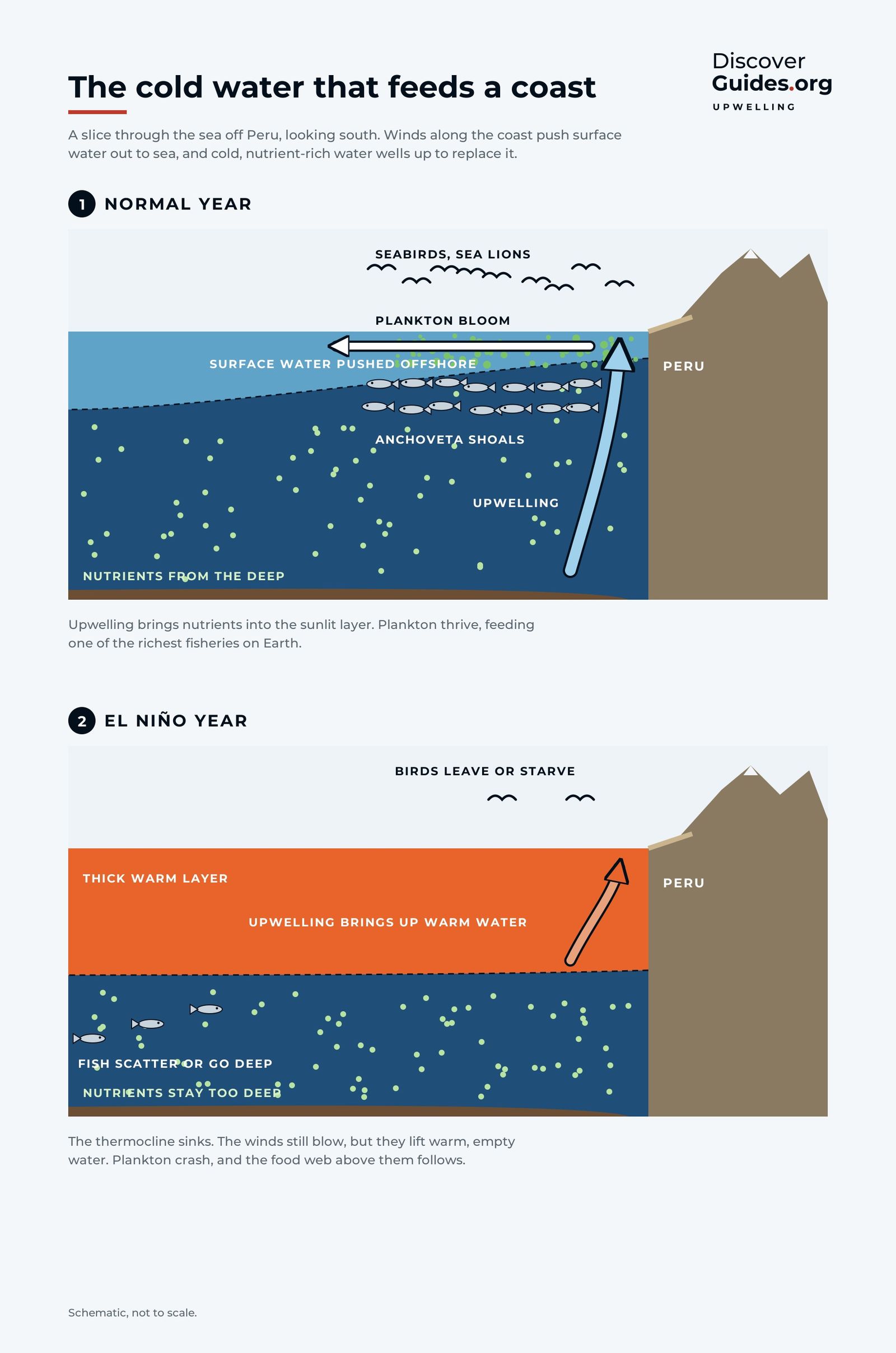
The graphic at the top shows the chain. Nutrients rising into sunlight feed phytoplankton, microscopic drifting plants. Phytoplankton feed zooplankton, zooplankton feed small fish, and small fish feed everything from seabirds to sea lions to people. NOAA notes that good fishing grounds are typically found where upwelling is common.
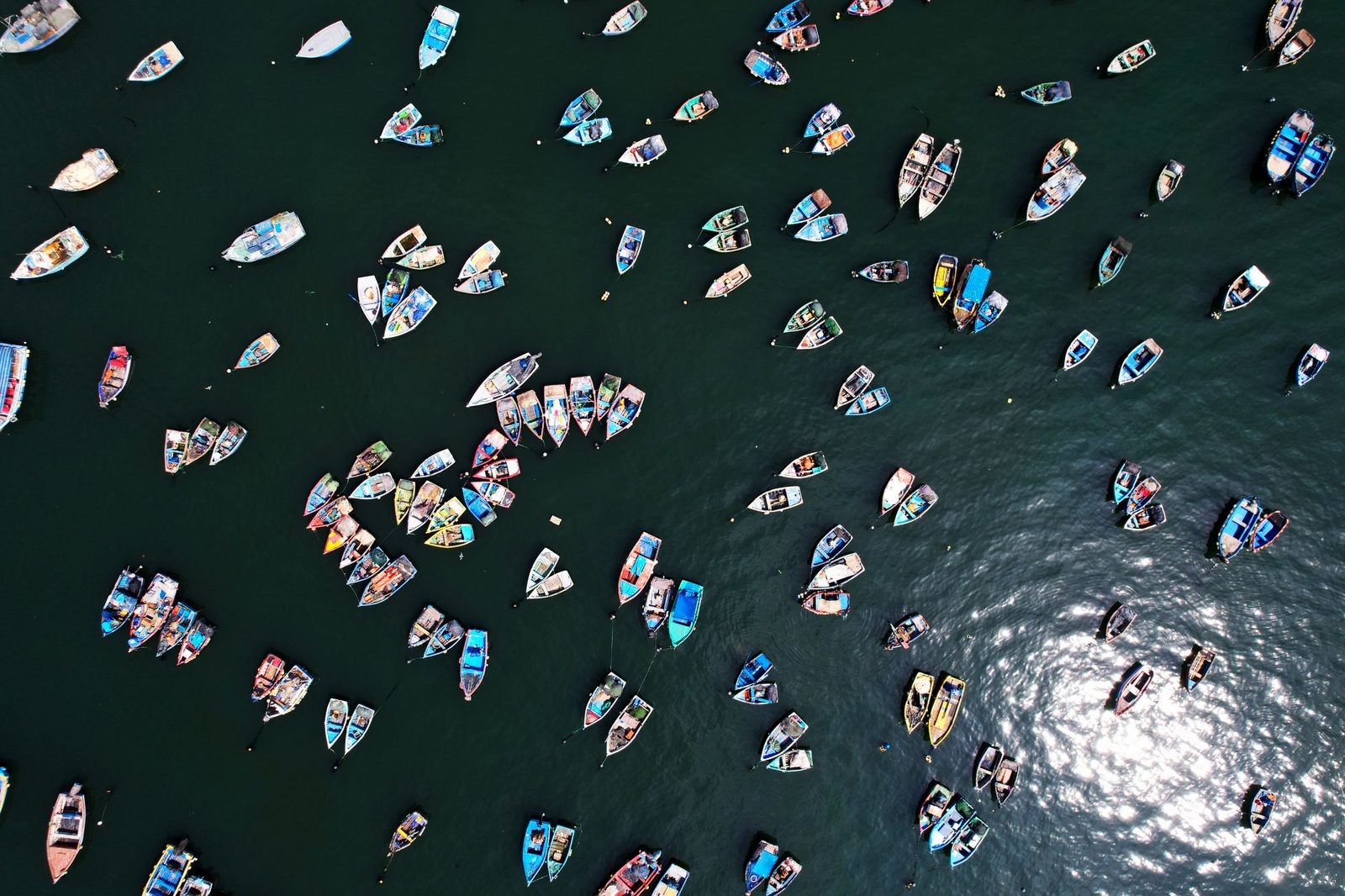
Off western South America all the pieces come together in the Humboldt Current System. A 2009 review in Progress in Oceanography identifies coastal upwelling as the key process behind its productivity and notes that the west coast of South America produces more fish per unit area than any other region of the world ocean. Its star is the Peruvian anchoveta, a small, fast-growing fish. According to NOAA's Michael McPhaden, Peru's anchoveta catch topped 10 million tonnes a year in the late 1960s and early 1970s, roughly one fifth of the entire world catch.
Where upwelling happens
- Peru and Chile: year-round upwelling in the Humboldt Current, the most productive coast on Earth.
- Namibia and north-west Africa: year-round upwelling that sustains rich fishing grounds off Africa's west coast.
- California: summer winds from the north drive upwelling, and the cold water helps produce San Francisco's famous summer fog.
- The equatorial Pacific: the trade winds lift a cold tongue of water west from South America.
Local tipOn a satellite map of ocean colour, upwelling zones show up as green ribbons of phytoplankton hugging the coasts of Peru, Chile, California, Namibia and north-west Africa, while the open subtropical oceans are a deep, empty blue.
What El Niño does to upwelling
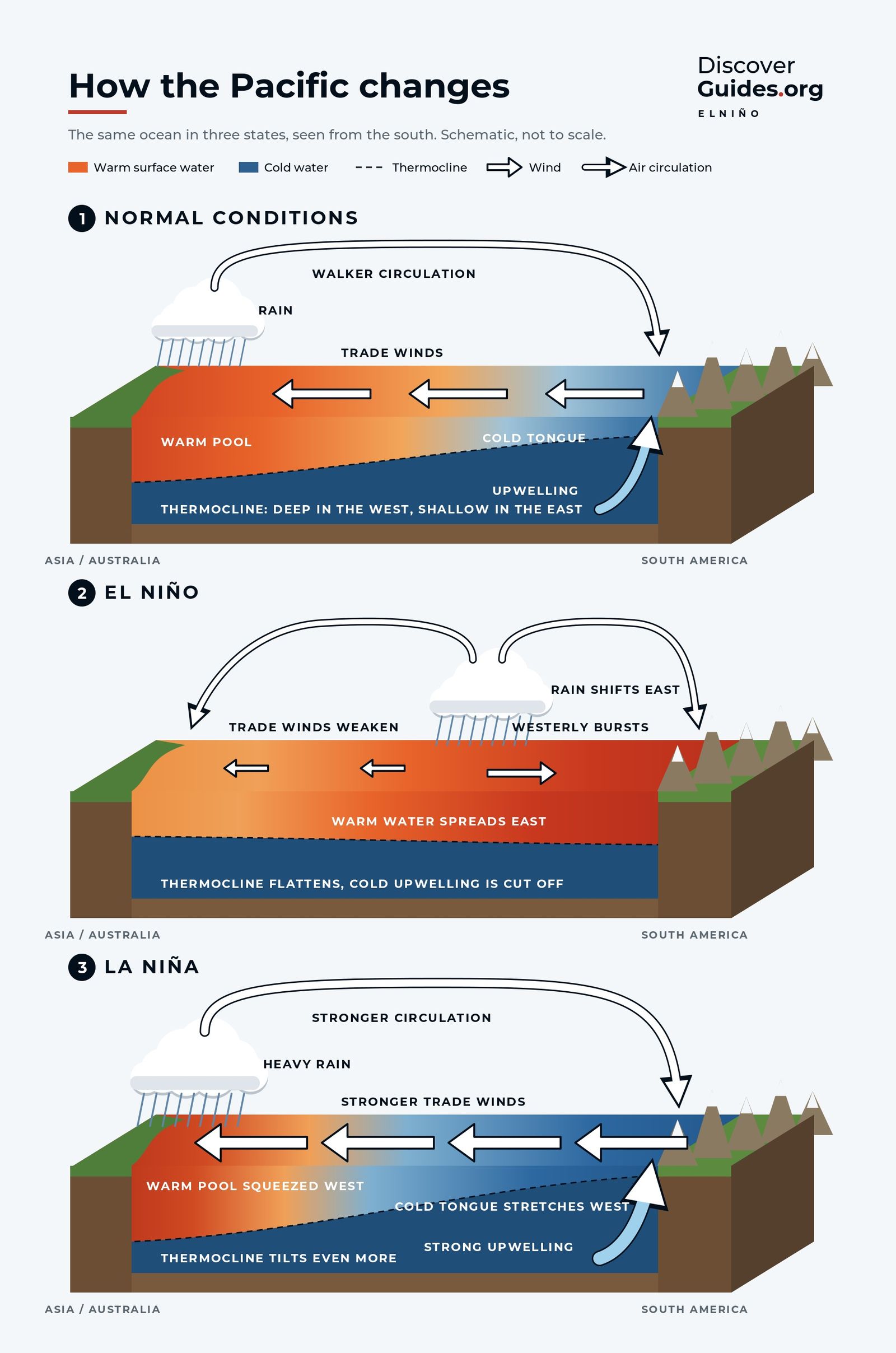
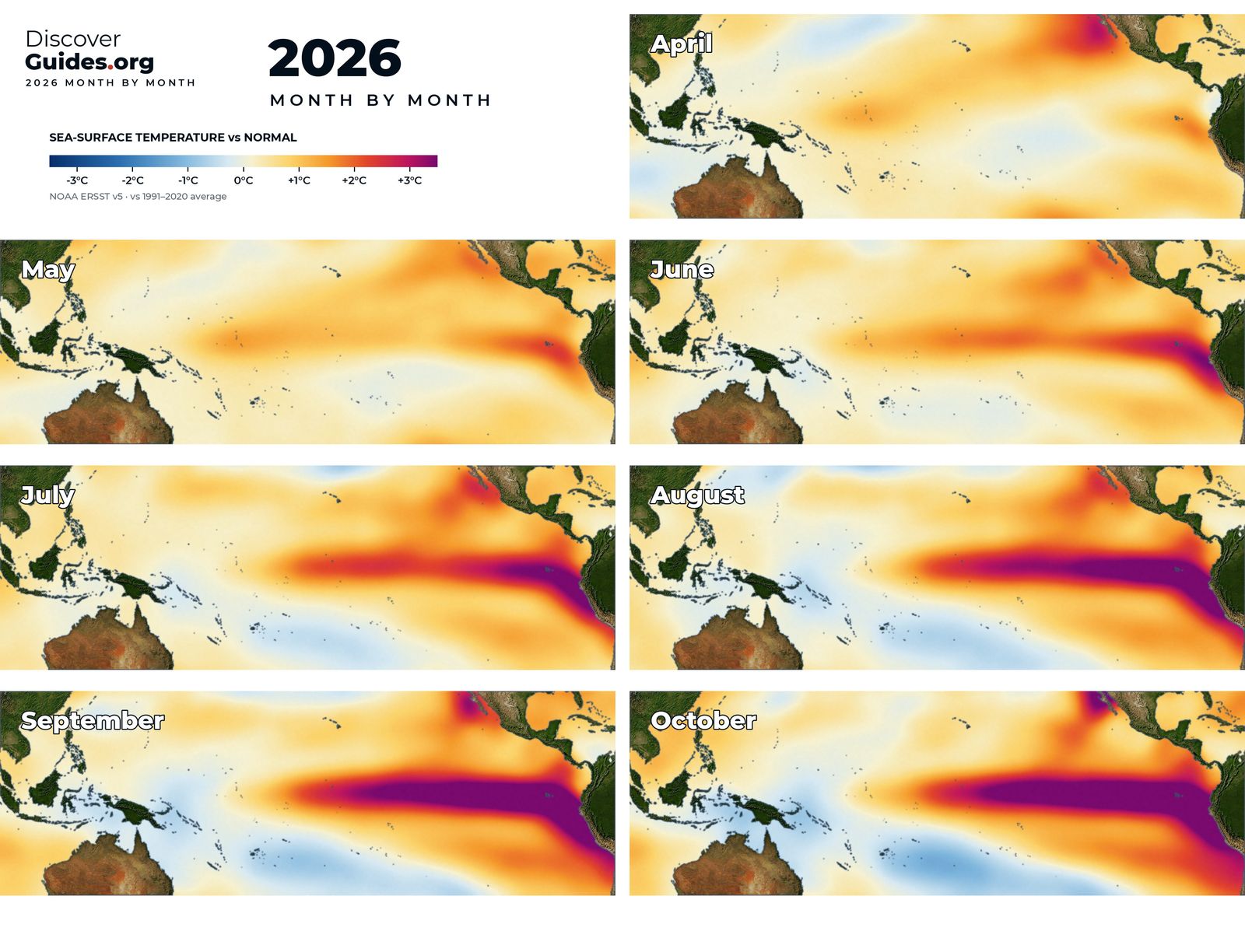
Across the equatorial Pacific the thermocline, the boundary above the cold deep water, normally lies about 150 metres deep in the west and only about 50 metres deep in the east. In the east, the wind can reach the cold water. During El Niño the thermocline sinks, and NOAA explains that upwelling along the Pacific coast of the Americas weakens or stops altogether. The water that does rise is warm and poor in nutrients. In the great El Niño of 1982-83, NOAA recorded the 17 °C isotherm at 110°W sinking to about 150 metres.
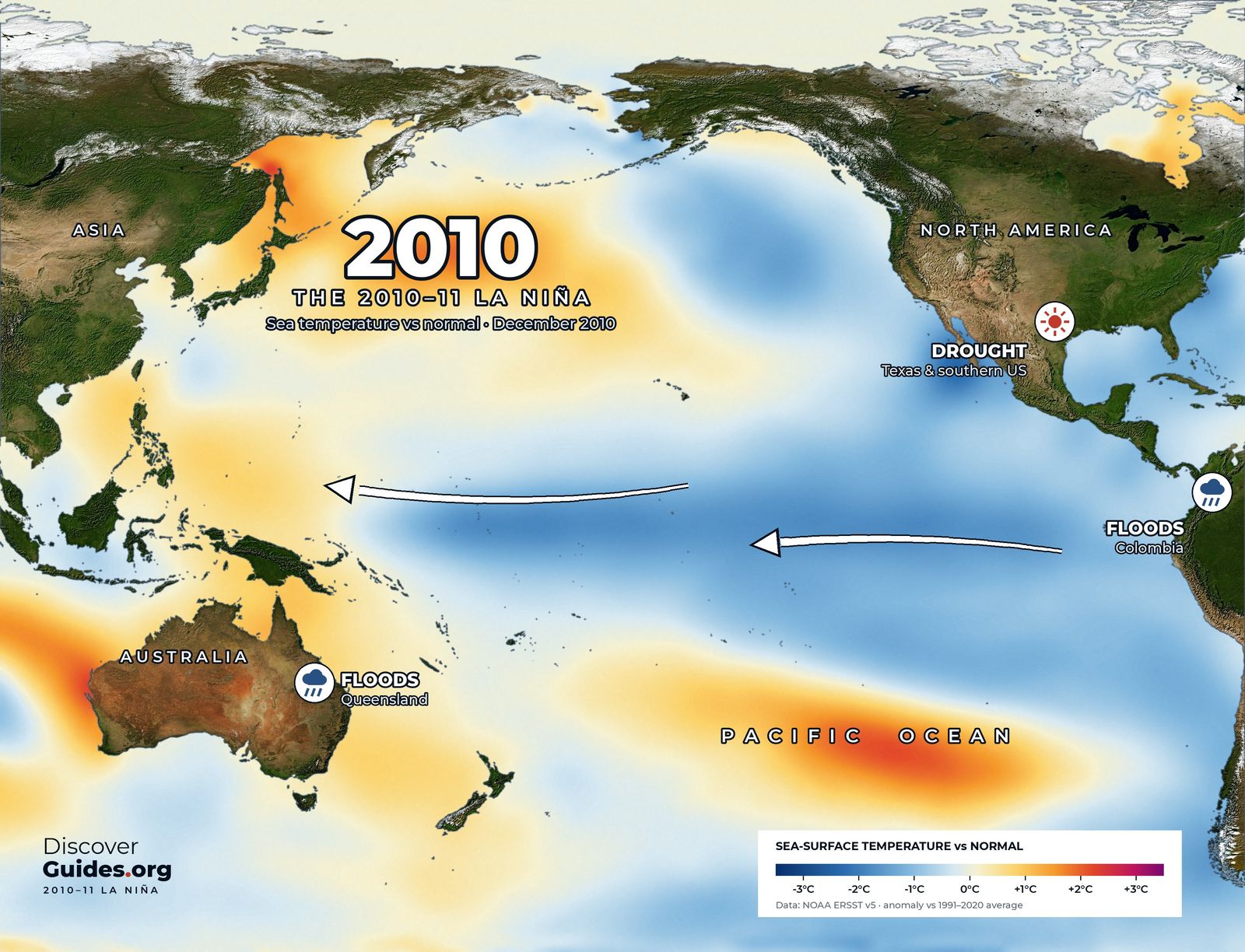
The food chain breaks from the bottom up. Phytoplankton decline, fish scatter or dive deeper, and seabirds abandon their nests. The fishery feels it at once (see El Niño 1972-73: The Year the Anchoveta Vanished). During La Niña the reverse happens: upwelling strengthens and coastal waters turn colder and richer.
| Year | What happened to Peru's anchoveta |
|---|---|
| 1970 | Catch peaks at 13.1 million tonnes |
| 1972-73 | Heavy fishing plus El Niño cause recruitment failure and stock collapse |
| 1982-83 | Strong El Niño reduces the stock to its historical minimum |
| 1997-98 | Another serious depletion; 1998 catch about 1.7 million tonnes |
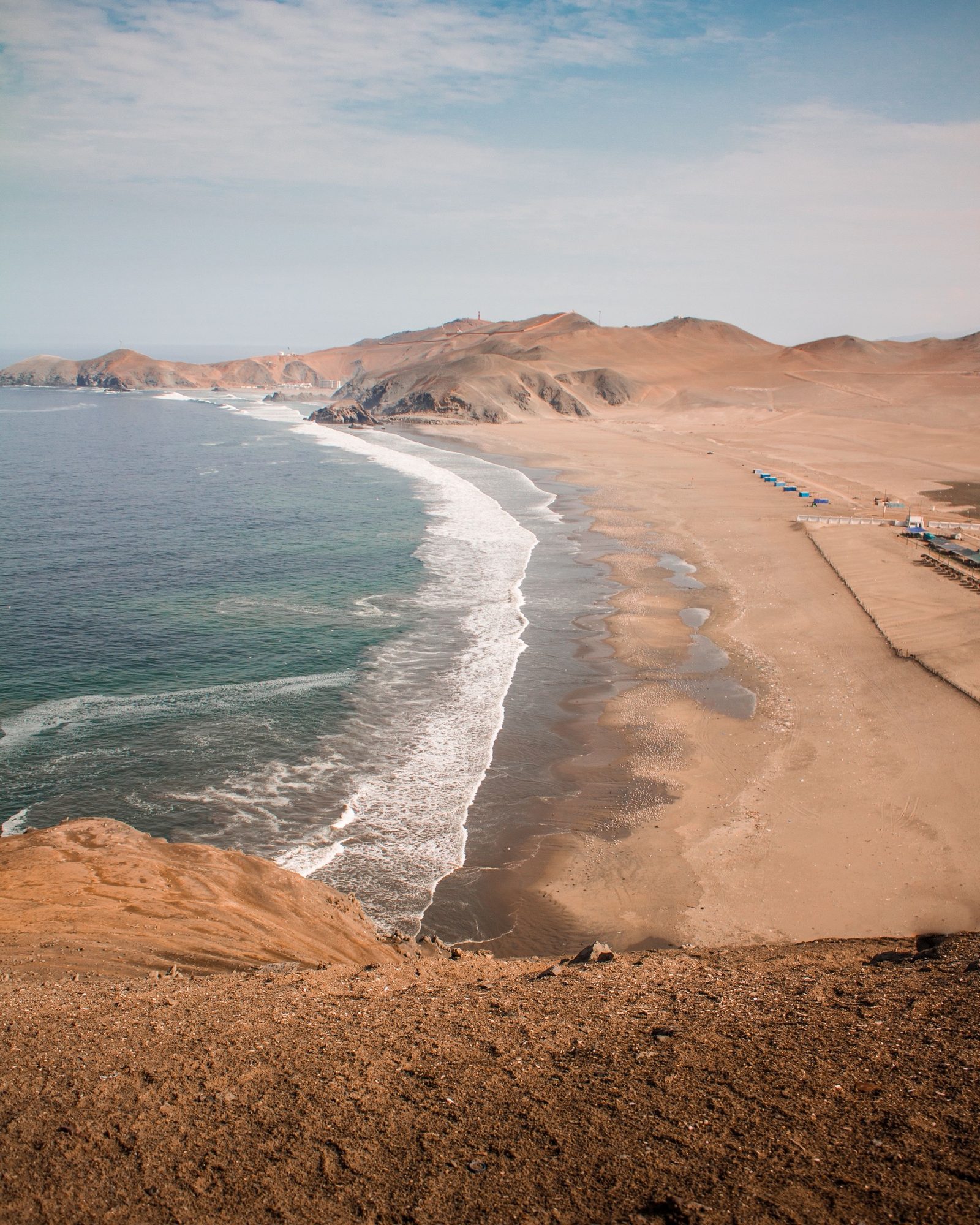
Upwelling even matters for the air. McPhaden estimated that equatorial Pacific upwelling normally releases about 1 billion tonnes of carbon to the atmosphere each year as carbon-rich deep water reaches the surface. When El Niño shuts it down, that outgassing drops. More on how the warm years ripple through sea life is in How El Niño Hits Galápagos Wildlife.
Questions
What is upwelling in simple terms?
Upwelling is when wind pushes surface water away from a coast or along the equator and cold, nutrient-rich water rises from below to replace it. The nutrients feed plankton, which feed fish and everything that eats fish.
Why is the sea off Peru so cold?
Winds blowing along the coast drive strong upwelling in the Humboldt Current System, lifting cold water from below. That cold water also keeps the coastal desert dry.
What happens to upwelling during El Niño?
It weakens or stops. The thermocline sinks too deep for the wind to reach cold water, so the water that rises is warm and poor in nutrients, and the food chain thins out.
Does La Niña increase upwelling?
Yes. Stronger trade winds drive stronger upwelling, and the waters off Peru turn colder and richer in nutrients.