At a glance
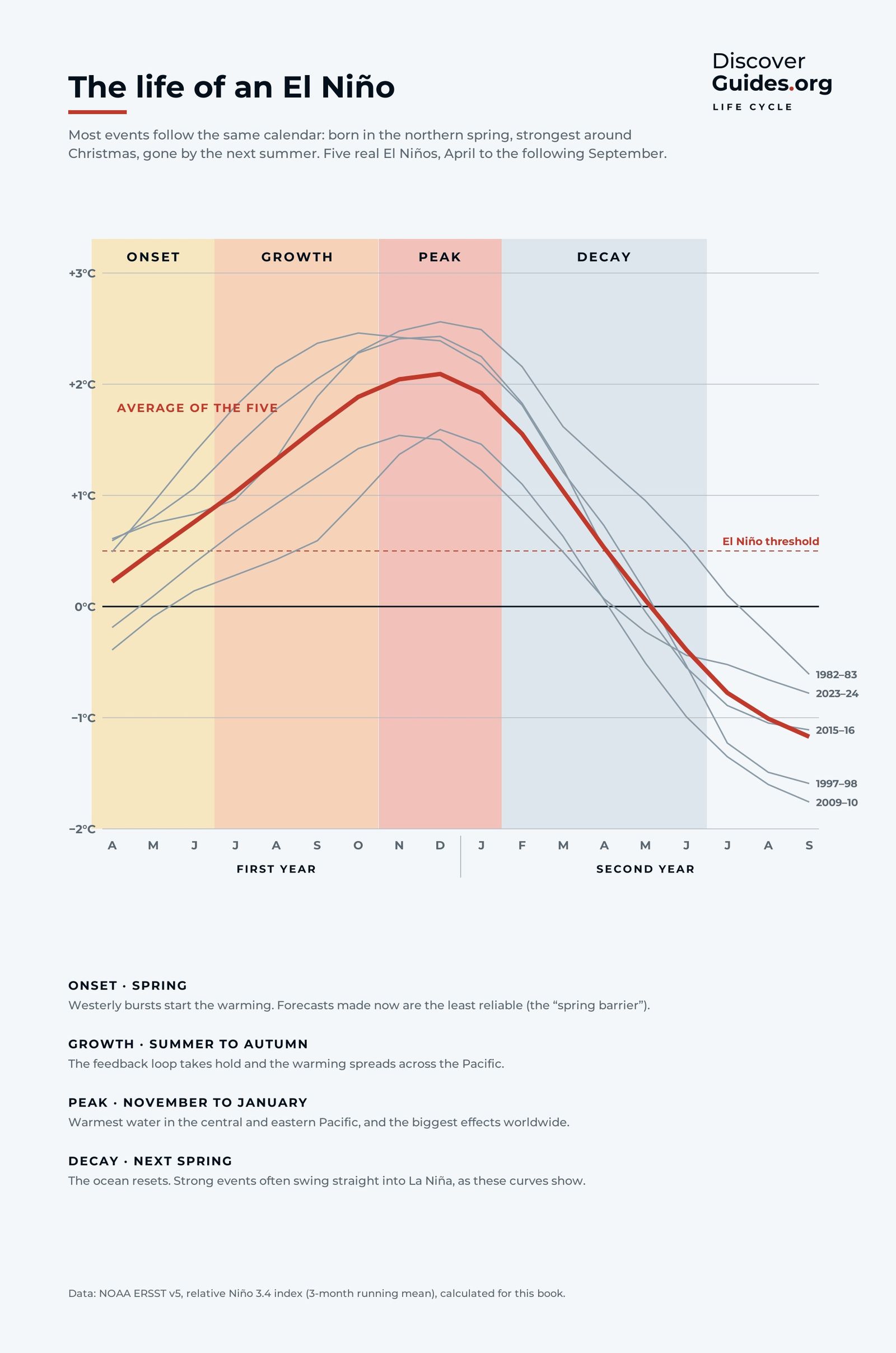
NOAA's Physical Sciences Laboratory describes a typical El Niño that begins to form between March and June, reaches its strongest between December and April, and weakens from late spring into summer. Most last 9 to 12 months. The longest El Niño on NOAA's record lasted 18 months. La Niña is the more persistent sibling, commonly lasting one to three years, with the longest on record at 33 months.
That seasonal rhythm is called phase locking. The Pacific is most open to ocean-atmosphere coupling in the northern summer and autumn and least in spring, so an event can be born almost any month but tends to grow through the autumn and peak around the turn of the year.
Stage 1: Recharge
Every El Niño starts with a store of heat. Scientists measure it as the warm water volume, the water warmer than 20 °C above the thermocline near the equator. Christopher Meinen and Michael McPhaden of NOAA showed in 2000 that this volume swells before El Niño, drains as the event develops, and leads eastern Pacific temperatures by about seven months. In 1997 the theorist Fei-Fei Jin described the whole cycle as a recharge oscillator: heat builds up in calm or La Niña years, El Niño spreads it east and pushes it away from the equator, and the slow refilling begins again.
Stage 2: Trigger
A full reservoir still needs a push. In the western Pacific it usually comes from westerly wind bursts, which launch Kelvin waves that carry warm water east beneath the surface (see Kelvin Waves Explained). Spring is the most treacherous season for forecasters. In 2014 an El Niño Watch was issued in March, but the winds never fully reversed and the event fizzled.
Stage 3: Growth and peak
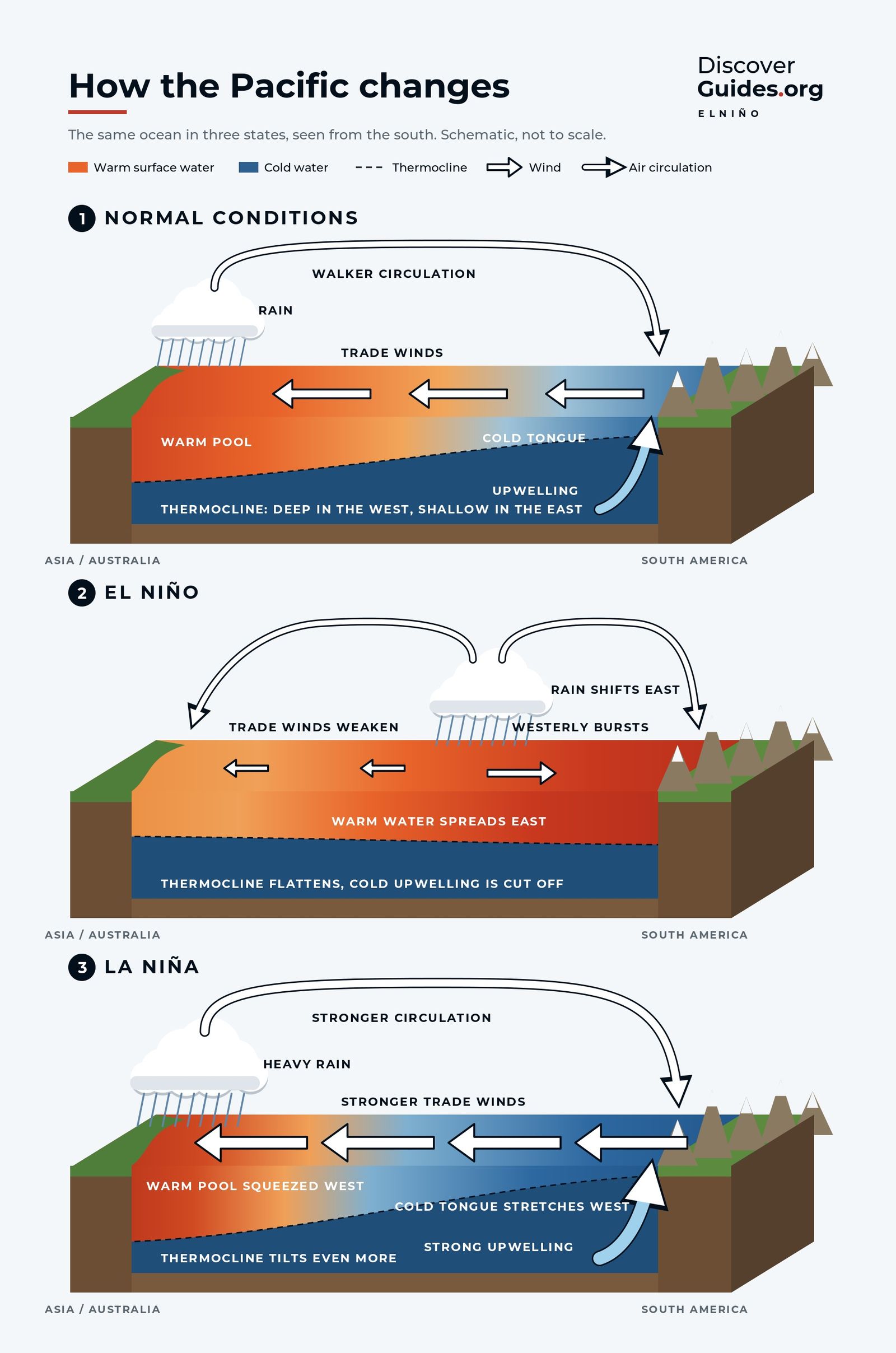
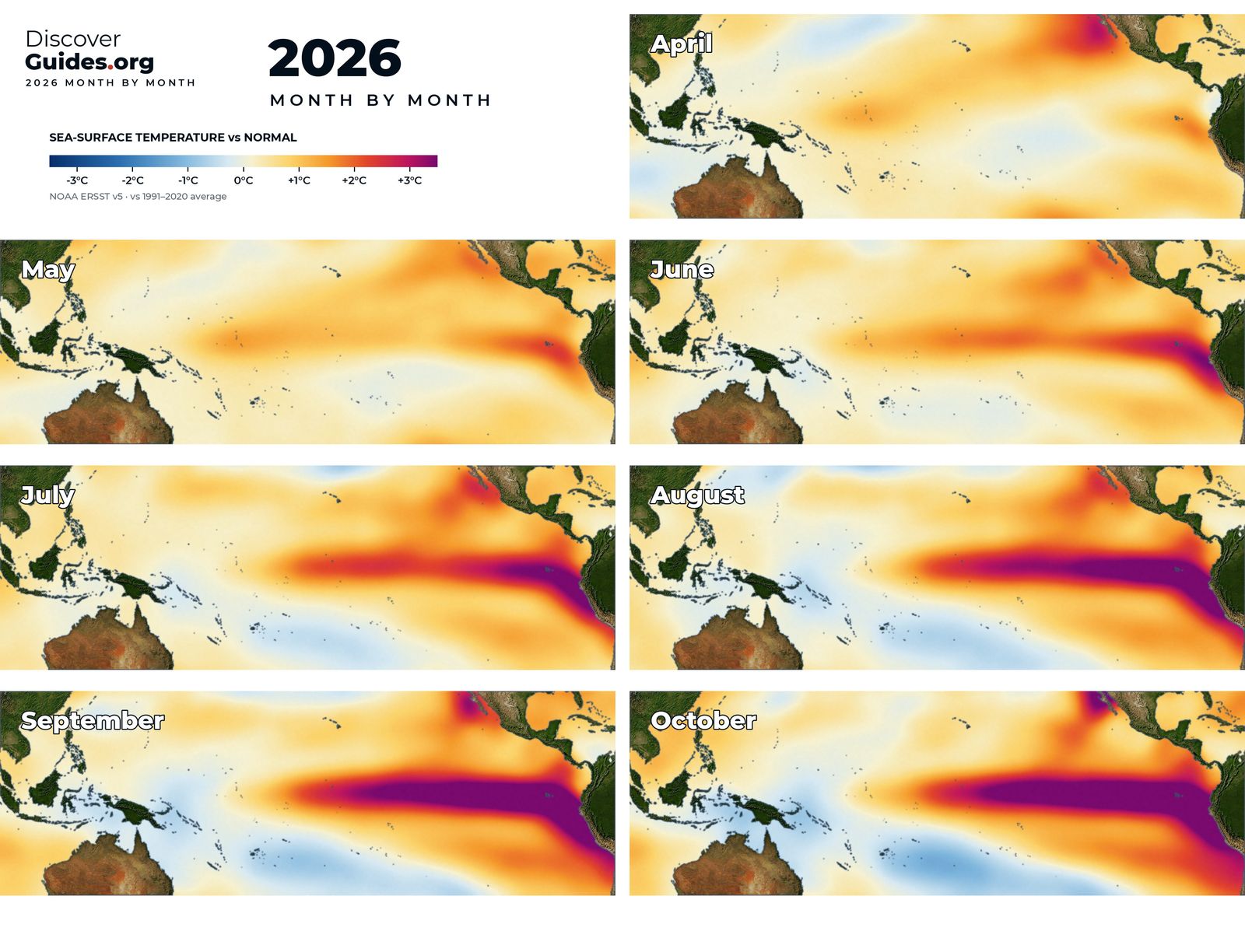
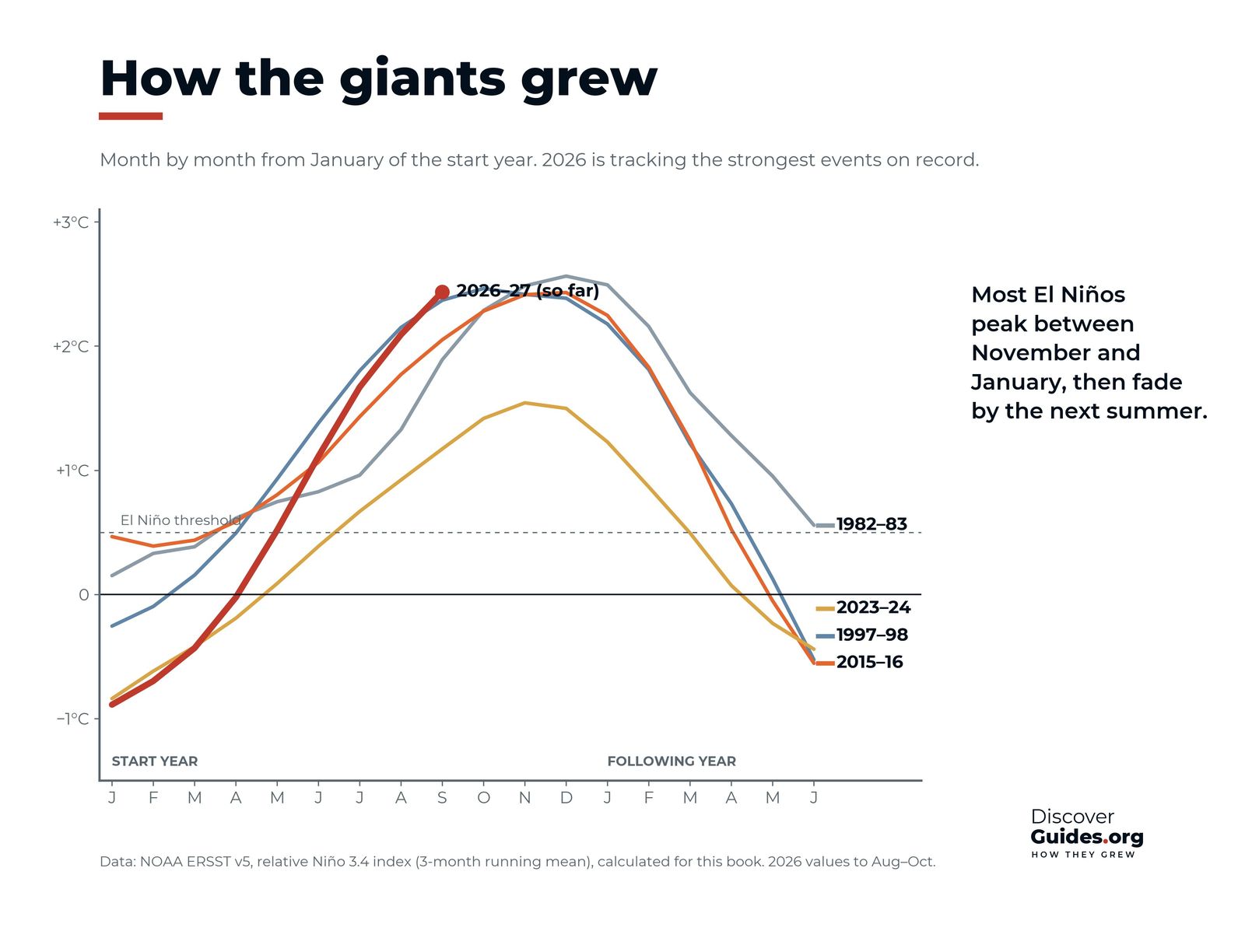
Once ocean and air lock together through the Bjerknes feedback (see The Bjerknes Feedback), the event grows month by month. In 1997 every month from June to December set a new sea temperature record in the eastern equatorial Pacific, and by December anomalies across the cold tongue averaged nearly 4 °C. The three-month peaks of 1982-83, 1997-98 and 2015-16 all fall in or next to November-January.
Stage 4: Collapse
El Niño carries the seeds of its own end. Its heat is flushed away from the equator, and its wind anomalies launch Rossby waves that reflect off the western Pacific and return east as a cold pulse. This delayed oscillator, proposed by Max Suarez and Paul Schopf in 1988, can end an event about six months after the winds that created it.
The end can be brutally fast. In mid-May 1998 the trade winds returned to near-normal strength in the eastern Pacific, and at 0°, 125°W the sea cooled by 8 °C in 30 days, more than ten times the normal rate for that season.
- 1996Loading
Heat builds in the western Pacific under strong trade winds; westerly wind bursts begin late in the year.
- Apr-May 1997Declared
Official El Niño pronouncements are made.
- Jun-Dec 1997Growth
Each month sets a new eastern Pacific temperature record; the thermocline sinks by more than 90 m.
- May 1998Collapse
Trade winds return; the sea at 0°, 125°W cools 8 °C in 30 days.
- Mid-1998La Niña
La Niña conditions take over.
What comes after El Niño?
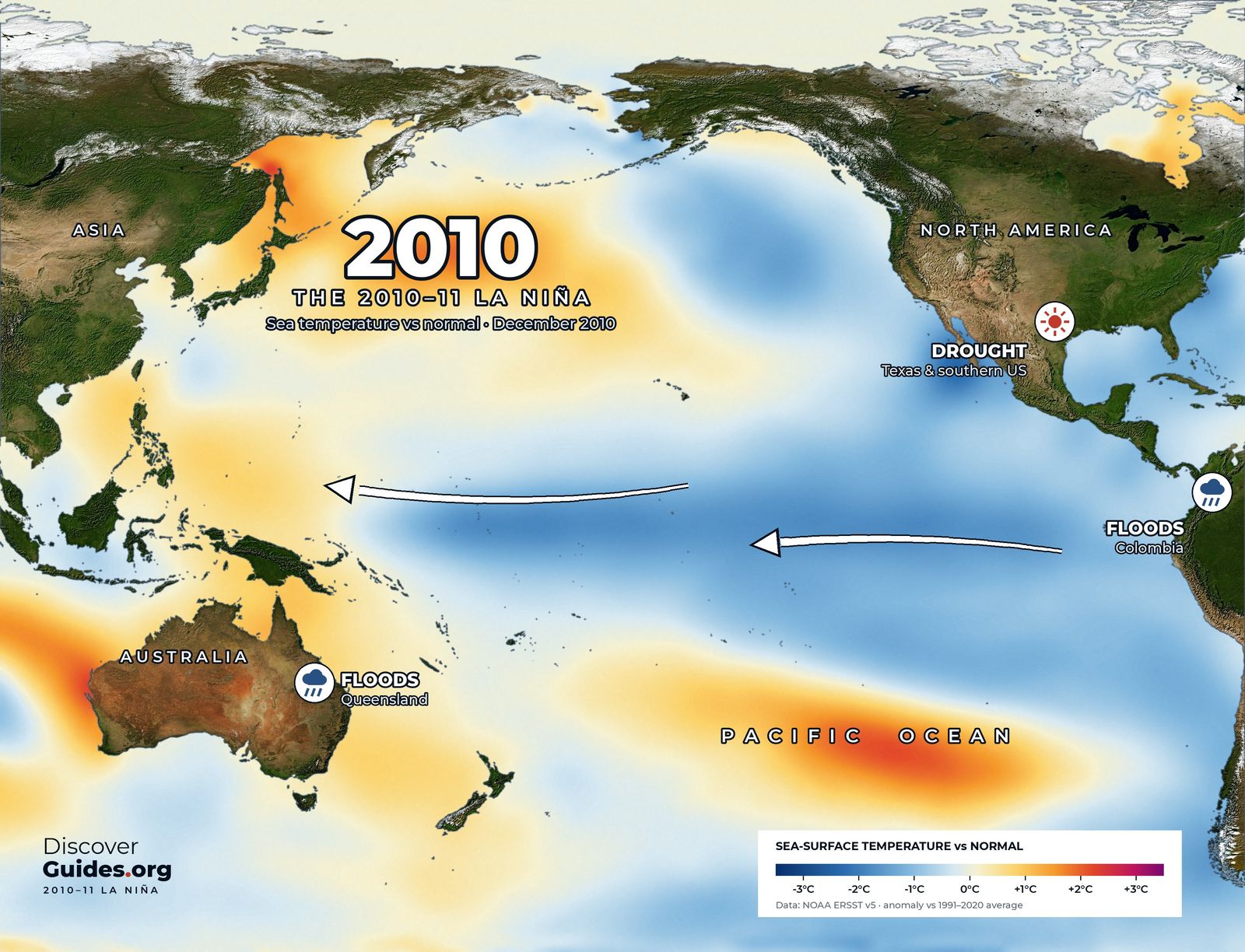
The cold pulse that kills an El Niño often overshoots. A 2016 analysis on NOAA's ENSO blog looked at the 21 El Niños since 1950. Of the ten moderate and strong events, six were followed by La Niña, and all three of the strong ones were. Weak events showed only a slight tendency to flip. The giant of 1997-98 gave way to the three-winter cold spell of 1998-2001 (see El Niño vs La Niña).
As of NOAA's October 2026 outlook, El Niño was expected to persist through March-May 2027 with neutral conditions favoured by April-June. None of the outlooks cited in the book favoured La Niña for 2027 as of early November 2026. The latest is tracked in The 2026-27 Super El Niño.
Questions
How long does an El Niño usually last?
Most El Niños last 9 to 12 months. They typically form between March and June, peak between December and April, and weaken from late spring into summer. The longest on NOAA's record lasted 18 months.
How often does El Niño happen?
El Niño and La Niña recur on average every two to seven years, never on a fixed timetable.
Does La Niña always follow El Niño?
No. Since 1950, six of ten moderate and strong El Niños were followed by La Niña, including all three strong ones, but many events simply fade into neutral conditions.
How fast can El Niño end?
Very fast. In May 1998 the sea at 0°, 125°W cooled by 8 °C in 30 days once the trade winds returned.