At a glance
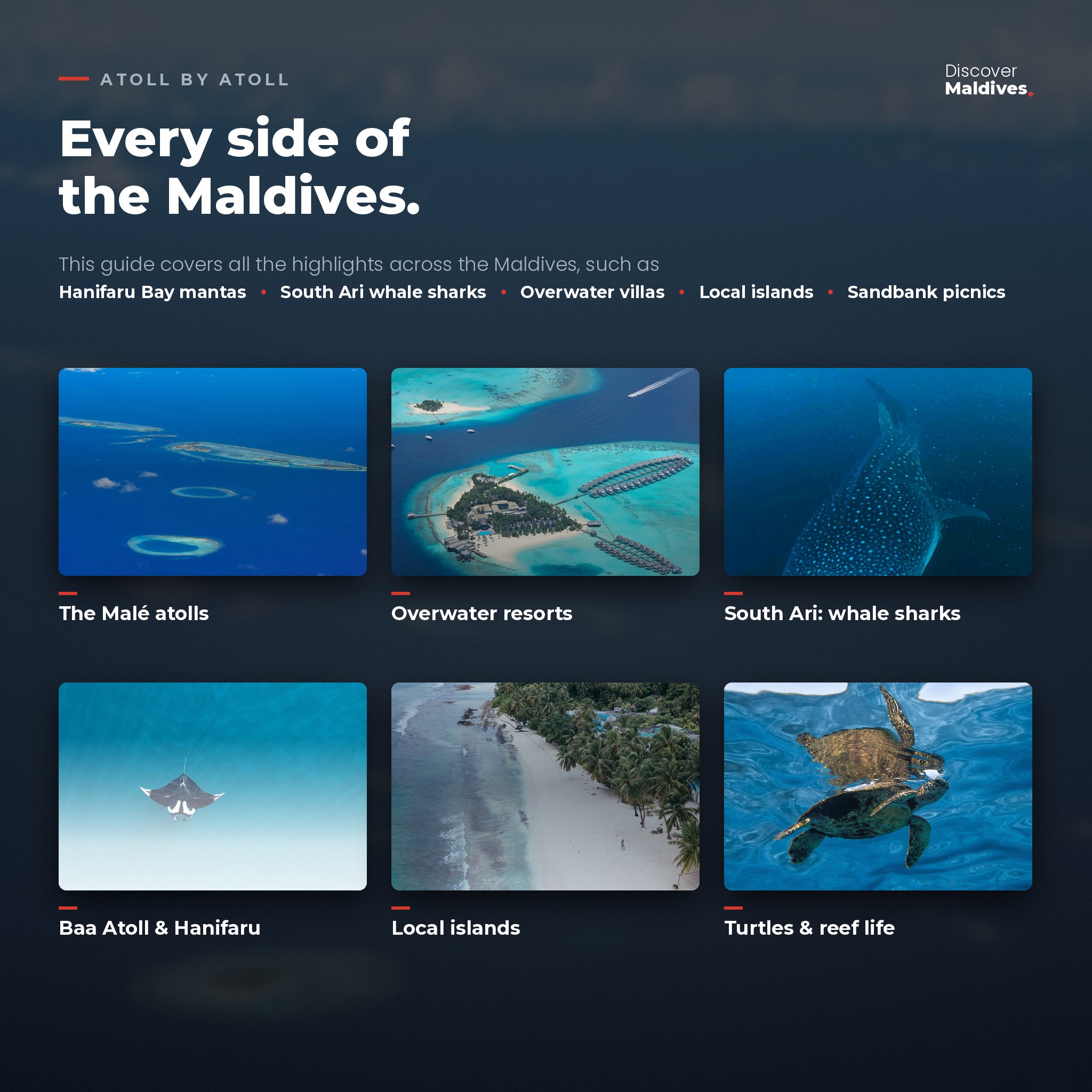
An atoll is a ring of coral reef enclosing a lagoon, dotted with islands and broken by channels where the ocean flows in and out. The Maldives has 26 of them, grouped for government into administrative atolls with letter names such as Kaafu, Alif Dhaal and Baa. Resorts and guesthouses often use either name, so it helps to know both.
For travellers, the atolls fall into a few natural groups: the Malé atolls near the airport, Ari to the west, the northern atolls such as Baa and Lhaviyani, the central atolls such as Vaavu, and the deep south.
Inside each atoll, the reef breaks into features that divers learn quickly: channels (kandu), where tides push water in and out and big animals gather; thilas, underwater pinnacles that rise close to the surface; and house reefs, the reef around your own island. The richest sites tend to be in the channels on the outer rim, which is why currents and the monsoon matter so much when choosing an atoll.
The atolls compared
| Getting there | Best for | |
|---|---|---|
| North and South Malé (Kaafu) | Speedboat from the airport | Short transfers, surf, local islands |
| Ari (Alif Alif, Alif Dhaal) | Seaplane, or flight to Maamigili | Whale sharks, mantas, diving |
| Baa | Seaplane, or flight to Dharavandhoo | Hanifaru Bay mantas |
| Vaavu | Speedboat | Channel diving, sharks |
| Laamu and Huvadhu | Domestic flight | Remote surf and quiet |
| Fuvahmulah and Addu | Domestic flight | Tiger sharks, south of the equator |
The Malé atolls: short transfers
North Malé and South Malé, together Kaafu Atoll, surround the capital and the international airport. Transfers are by speedboat, often well under an hour, which makes them ideal for a short trip, a late arrival or anyone who wants to avoid the seaplane. North Malé has many of the country's best-known surf breaks, and local islands such as Maafushi and Thulusdhoo make Kaafu the easiest place to start on a budget.
Ari: whale sharks and mantas
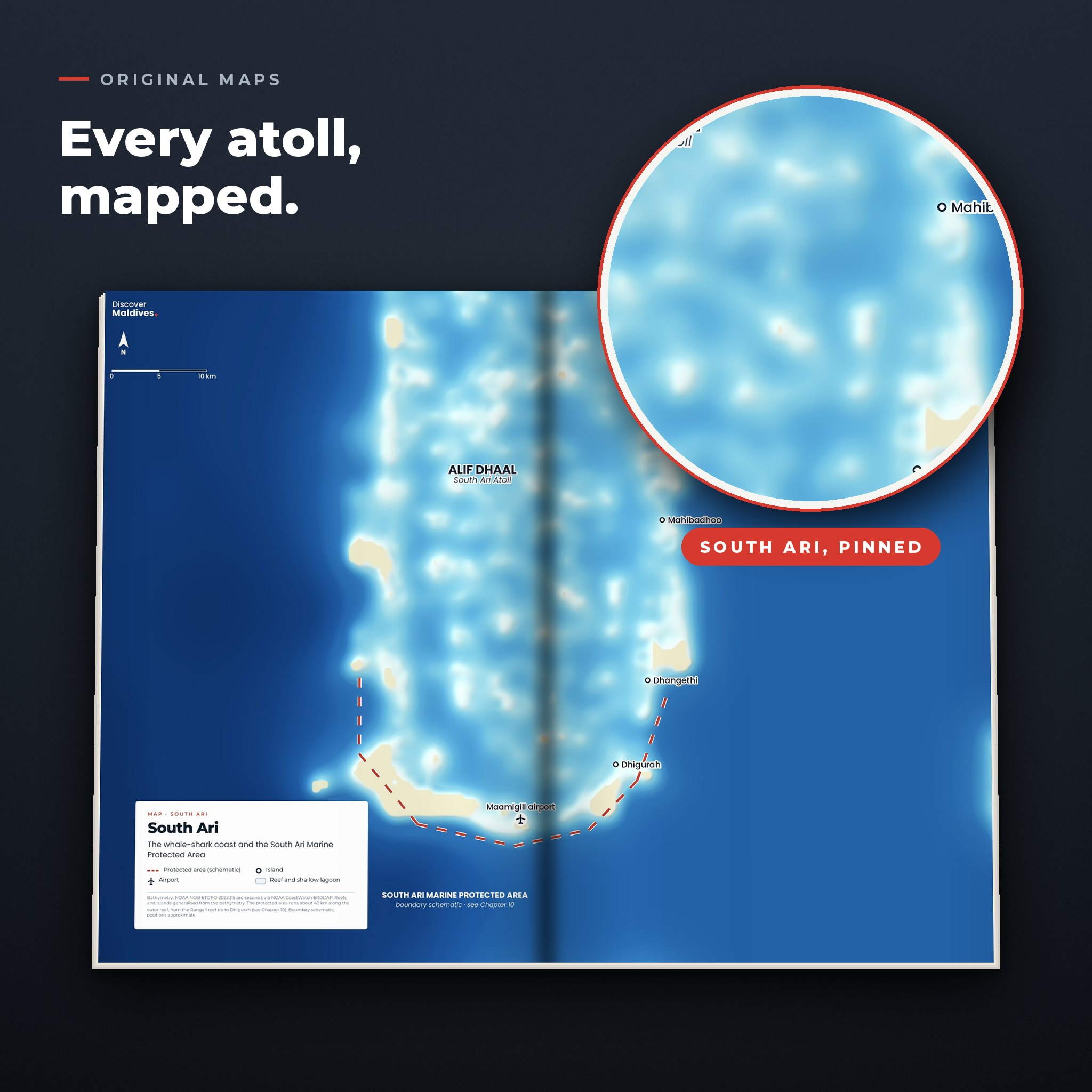
West of Malé, Ari is split into Alif Alif (North Ari) and Alif Dhaal (South Ari). It is one of the richest diving regions in the country. Along about 42 km of outer reef on the southern rim of South Ari, young whale sharks cruise near the surface in every month of the year, protected by the South Ari Marine Protected Area. Resorts are reached by seaplane or by a domestic flight to Maamigili, and guesthouses gather on islands such as Dhigurah and Ukulhas.
Baa and the north: mantas
Baa Atoll is a UNESCO Biosphere Reserve, and its small bay of Hanifaru draws mass gatherings of manta rays in the south-west monsoon, peaking from about June to November. The bay is snorkel only in season, with limited daily entries. Further north, Lhaviyani and Raa offer quieter resorts and good diving within seaplane range.
Between Ari and North Malé lies Rasdhoo, a small atoll whose local island is known among divers for an early-morning dive in search of hammerhead sharks. It is an easy add-on to an Ari or Malé trip by speedboat.
Vaavu: channels and sharks
South of the Malé atolls, Vaavu is small and close enough for a speedboat. Its channels are known among divers for strong currents and shark encounters, and islands such as Fulidhoo are dive-focused bases. It suits experienced divers more than beginners.
The deep south: Laamu, Huvadhu, Fuvahmulah and Addu
The southern atolls are reached by domestic flight and feel far from the crowds. Laamu and Huvadhu (Gaafu Alif and Gaafu Dhaal) are known for remote surf and wide, empty lagoons. Fuvahmulah is the only atoll in the country made of a single island, and its harbour is famous for tiger sharks seen on dives all year. Addu, the southernmost atoll, lies just south of the equator, with an airport at Gan built by the British and a manta cleaning station.
Local tipSeaplanes fly only in daylight. If your flight lands late, choose the Malé atolls, or plan a night near the airport before a seaplane or domestic flight.
How to choose
- Short trip or late arrival: North or South Malé.
- Whale sharks: South Ari, any month.
- Mantas in season: Baa, June to November.
- Big-animal diving: Ari, Vaavu or Fuvahmulah.
- Surf: North Malé, Laamu or Huvadhu.
- Budget: a local island in Kaafu, South Ari or Baa. See the Maldives on a budget.
One more practical point: names on booking sites mix the two systems. A resort listed in Alif Dhaal is in South Ari, Kaafu covers both Malé atolls, and Gaafu Alif and Gaafu Dhaal are the two halves of Huvadhu. Check which natural atoll you are in before you compare transfers.
Season matters as much as place, because the monsoons move mantas, swell and visibility from one side of the atolls to the other. Pair this guide with the best time to visit the Maldives. The Discover Maldives guide covers all 26 atolls with original maps, transfers and the best season for each.
Questions
How many atolls are there in the Maldives?
The Maldives has 26 natural atolls, grouped for administration into lettered administrative atolls such as Kaafu, Alif Dhaal and Baa.
Which Maldives atoll is best for whale sharks?
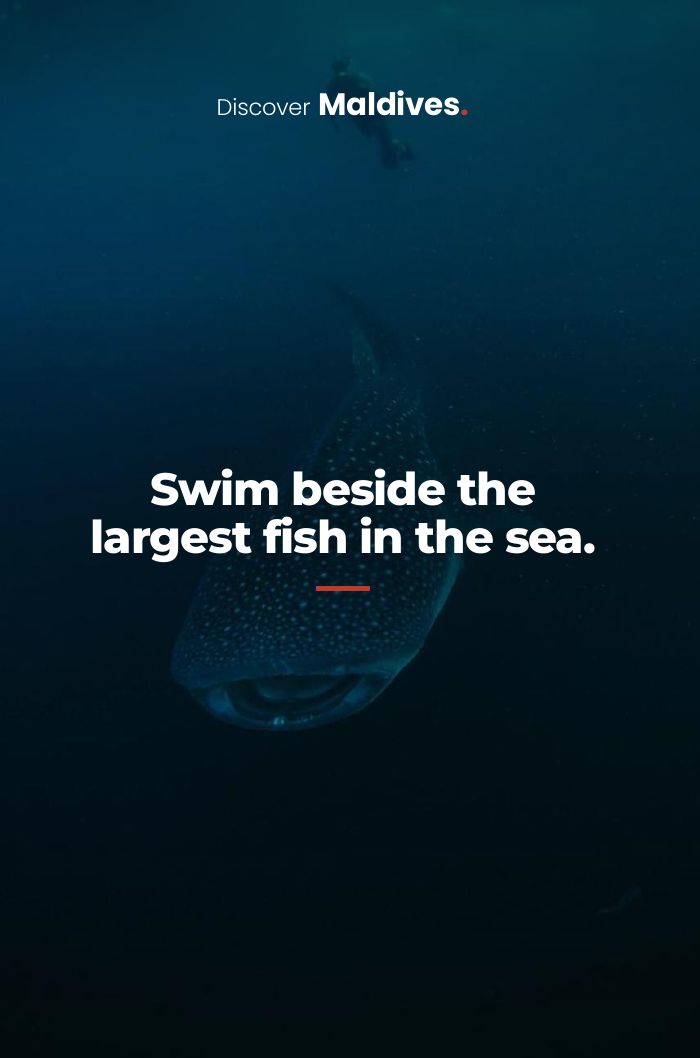
South Ari (Alif Dhaal). Along the outer reef of the South Ari Marine Protected Area, young whale sharks can be found in every month of the year.
Which Maldives atoll is closest to the airport?
Kaafu, which includes North and South Malé atolls. Resorts and local islands there are reached by speedboat, without a seaplane or domestic flight.
Which atoll is best for mantas?
Baa Atoll, home to Hanifaru Bay, where mass manta gatherings peak from about June to November. Mantas are also seen at cleaning stations in Ari and Addu.