At a glance
All international flights land at Faa'a on Tahiti, and almost every trip begins there. From Tahiti, Moorea is a short ferry ride away, and Air Tahiti flies to the rest. The islands fall into two very different types: high volcanic islands, green and mountainous and wrapped in lagoons, and low coral atolls, rings of sand and palms around a lagoon with passes to the ocean.
The five archipelagos compared
| Archipelago | Main islands | Best for |
|---|---|---|
| Society Islands | Tahiti, Moorea, Bora Bora, Huahine, Raiatea, Taha'a, Maupiti | Lagoons, peaks, overwater bungalows |
| Tuamotu | Rangiroa, Fakarava, Tikehau | Diving, sharks, dolphins, empty atolls |
| Marquesas | Nuku Hiva, Hiva Oa | Culture, wild landscapes, no lagoons |
| Austral Islands | Rurutu, Tubuai | Whales in season, quiet villages |
| Gambier | Mangareva | The most remote travel of all |
The Society Islands
The Society Islands are where most trips happen, and the group divides into the Windward Islands, Tahiti and Moorea, and the Leeward Islands to the north-west.
- Tahiti: the largest island and the capital, Papeete. Worth a day or two for the market, the black-sand beaches and the waterfall valleys of the interior.
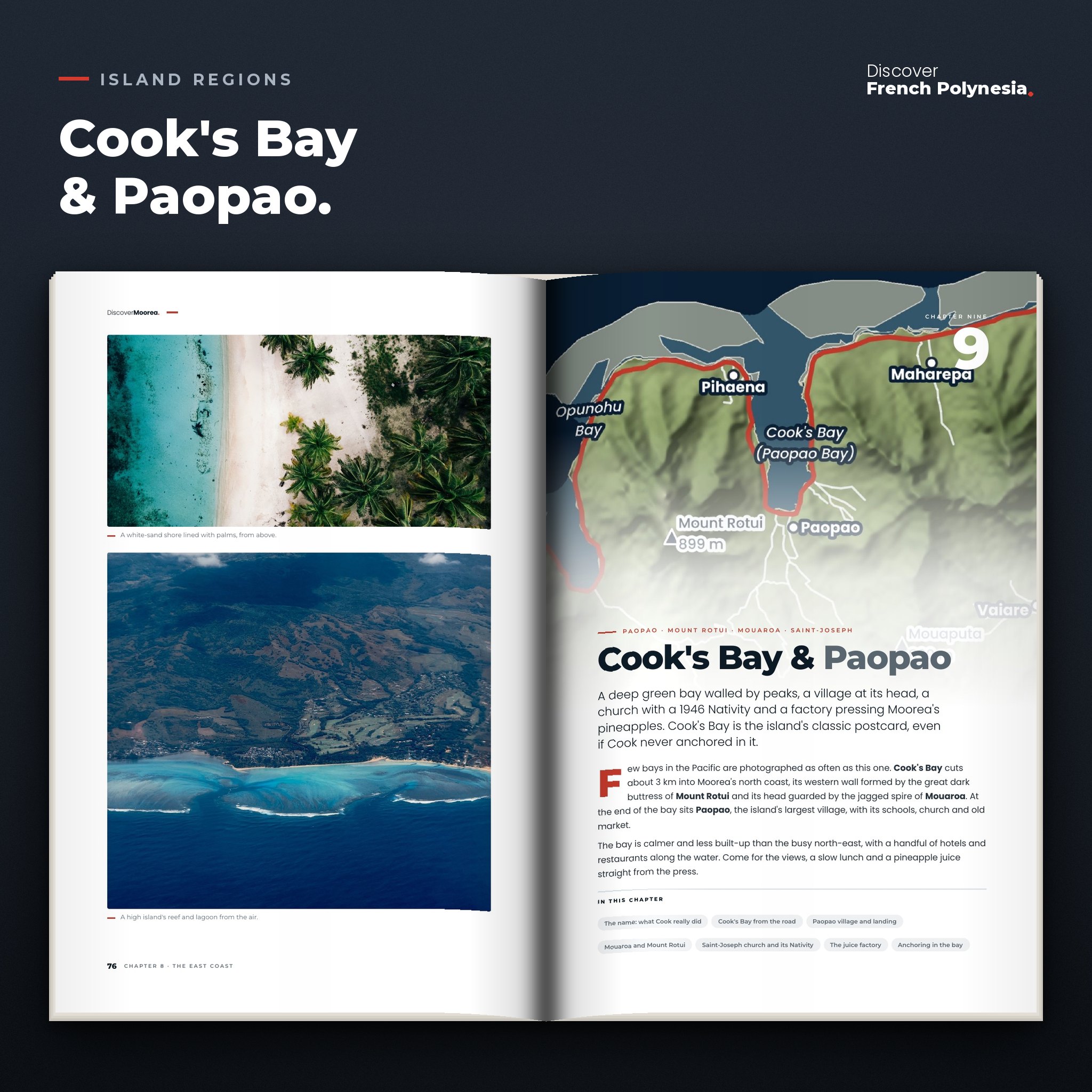
- Moorea: 25 to 45 minutes by ferry from Papeete. Jagged peaks, two great bays and a lagoon full of rays and reef sharks.
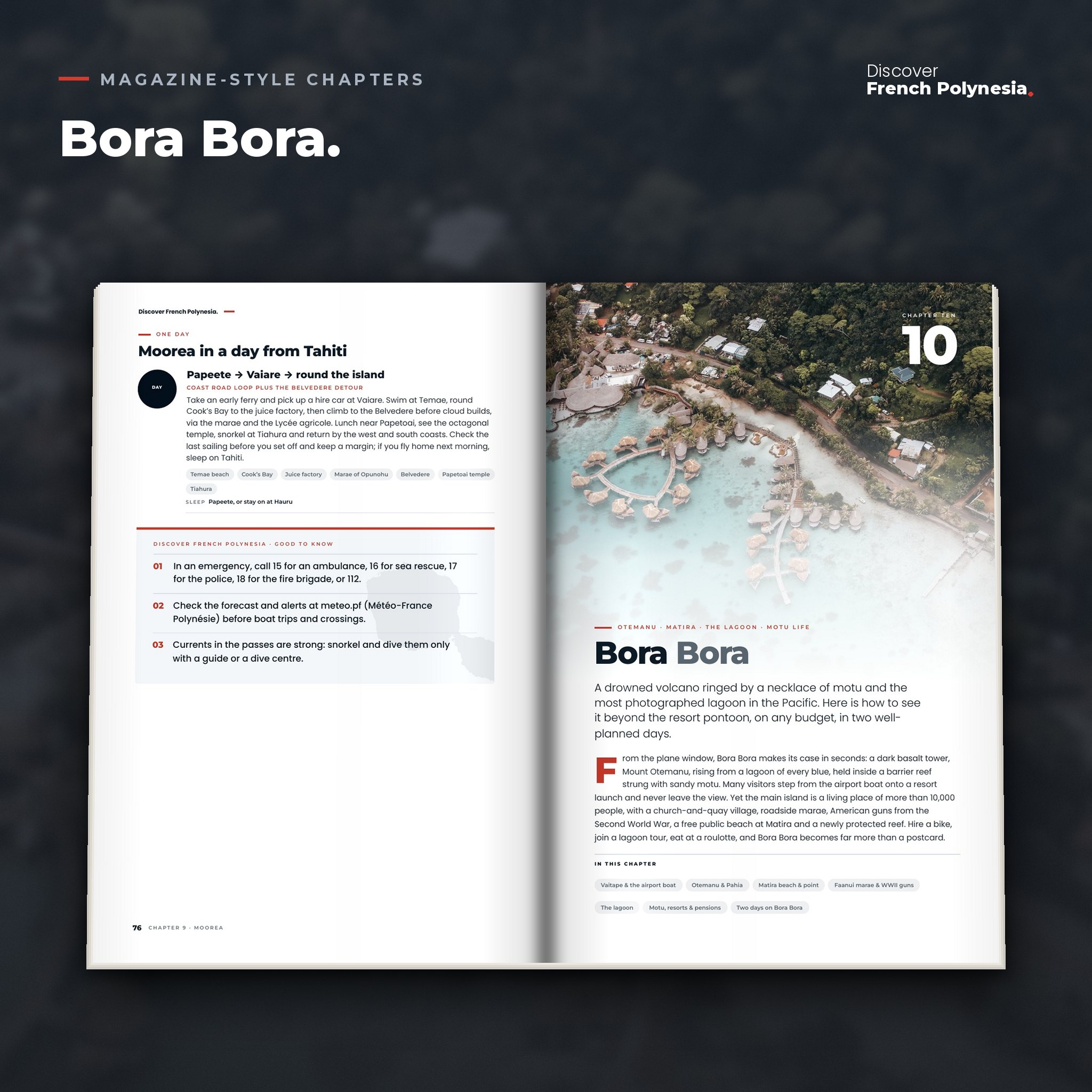
- Bora Bora: about 50 minutes by air from Tahiti. Mount Otemanu, 727 m, rises over the most famous lagoon in the Pacific, ringed by motu with overwater bungalows.
- Huahine: quiet and green, with ancient marae and a slower village pace.
- Raiatea and Taha'a: two islands inside one lagoon. Raiatea's Taputapuatea marae was added to the UNESCO World Heritage List in 2017. Taha'a is known for vanilla.
- Maupiti: a small Bora Bora without the resorts, with family guesthouses and a narrow pass.
Choosing between the two most famous? Our guide to Moorea or Bora Bora compares them side by side.
The Tuamotu atolls
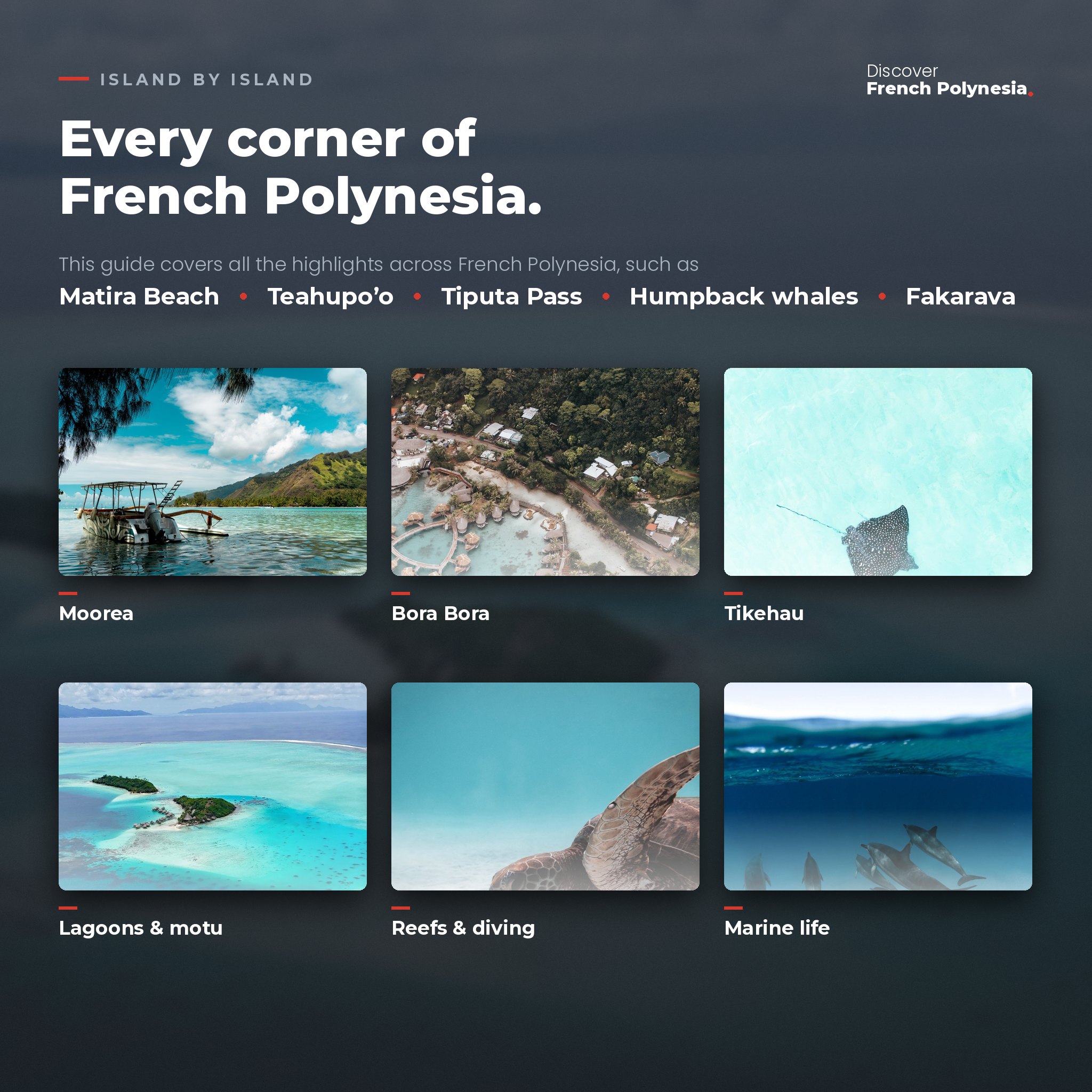
The Tuamotus are the world of the atoll: flat rings of coral and sand, with lagoons so large you cannot see across them. Rangiroa is the largest atoll in the group, with around 415 motu, and its Tiputa Pass is famous for bottlenose dolphins that swim close to divers. Fakarava, the second largest, is a UNESCO biosphere reserve. Its south pass, Tumakohua, is known for gatherings of grey reef sharks, and in July, before the full moon, marbled groupers mass there to spawn.
Tikehau is smaller and gentler, with pink-sand motu and a lagoon that suits snorkellers as well as divers. The atolls are about the water: there are no mountains, few roads and little nightlife.
SafetyCurrents in the passes of the atolls and the high islands are strong and change with the tide. Snorkel and dive the passes only with a local guide or dive centre.
The Marquesas, Australs and Gambier
The Marquesas lie far to the north-east and are a different world: no lagoons and few beaches, but towering green islands, deep valleys and the strongest traditions of Polynesian carving and tattoo. Nuku Hiva and Hiva Oa are the main islands, reached by Air Tahiti or by the passenger-freighter Aranui 5, which sails from Papeete.
The Austral Islands to the south, Rurutu and Tubuai among them, are cooler and quieter, and Rurutu is known for humpback whales in season. The Gambier islands, around Mangareva, are the most remote of all.
Getting around: Air Tahiti passes
Air Tahiti's multi-island passes are the simplest way to see several islands. Each pass starts on Tahiti or Moorea, visits a set group of islands in order and returns to Tahiti, with a maximum of 28 days from the first flight. The Maeva pass covers Huahine, Raiatea, Bora Bora and Moorea; the Maupiti pass adds Maupiti; the Tuamotu pass covers Rangiroa, Tikehau and Fakarava; and the Reva pass combines the Society Islands and the Tuamotus. Pass rules and fares change, so check the current versions before you book.
Local tipMoorea is easiest by ferry from Papeete. Save the flights on your pass for the islands you cannot reach by sea.
When to go and how to combine
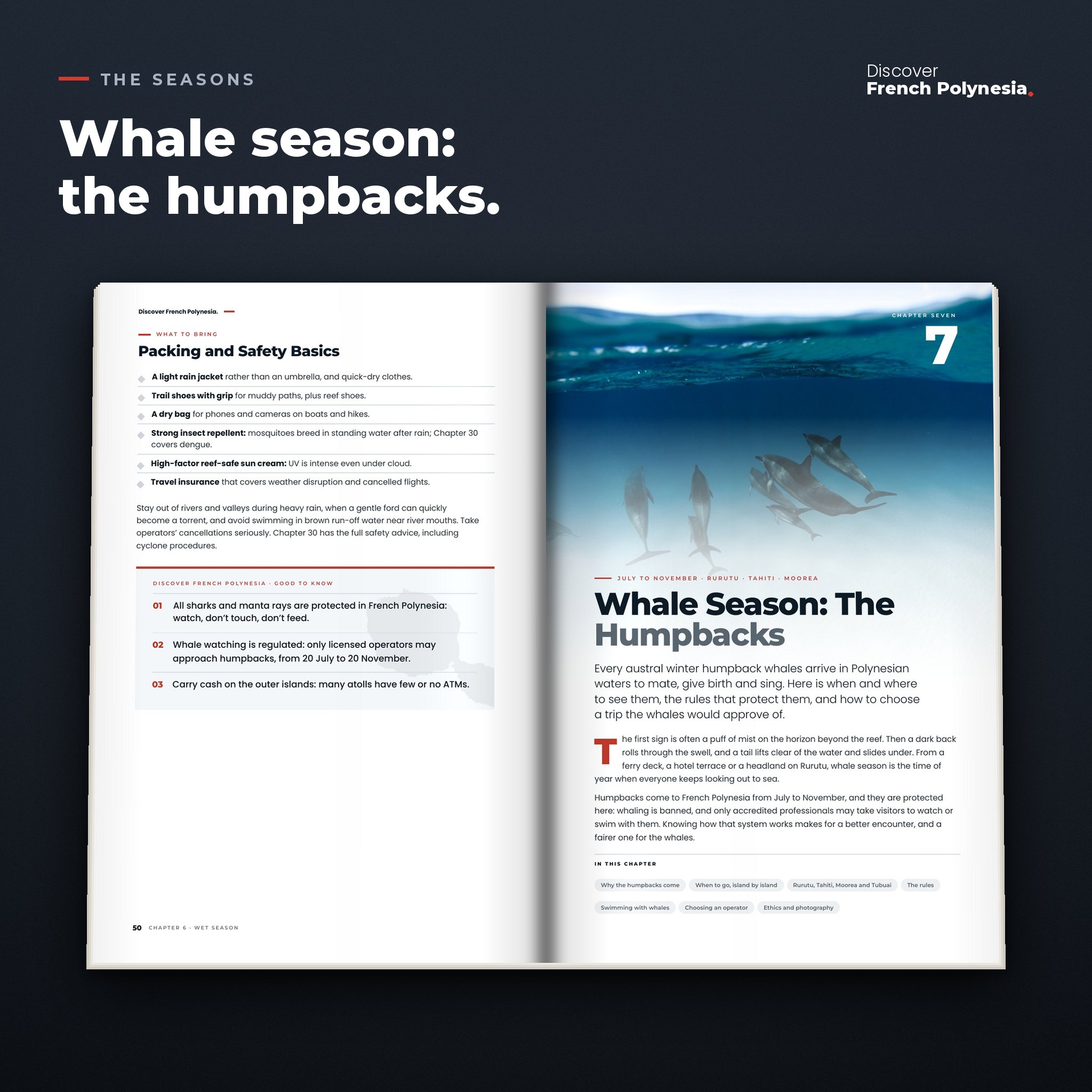
In the Society Islands and the Tuamotus, the drier season runs roughly from April or May to October, and the wetter, greener season from November to March. The Marquesas run later, with their driest months from August to December. Humpback whales are in Polynesian waters from July to November. June to August is the busiest period; late October to early December and January to March are usually cheaper.
- One week: Tahiti, Moorea and Bora Bora.
- Ten days: add Huahine or Raiatea and Taha'a.
- Two weeks: the Society Islands plus one or two Tuamotu atolls, such as Rangiroa and Fakarava.
Weighing the South Pacific more widely? See our guide to which Fiji islands suit which trip. All five archipelagos, island by island, with 16 original maps, are in Discover French Polynesia.
Questions
How many islands are there in French Polynesia?
There are 118 islands in five archipelagos: the Society Islands, the Tuamotus, the Marquesas, the Austral Islands and the Gambier.
Which French Polynesia islands are best for a first visit?
Tahiti, Moorea and Bora Bora are the classic first trip. With more time, add Huahine, Raiatea and Taha'a, or an atoll in the Tuamotus such as Rangiroa or Fakarava.
How do you get between islands in French Polynesia?
By Air Tahiti flights, often booked as a multi-island pass, and by ferry between Tahiti and Moorea. The Marquesas can also be reached on the Aranui 5 passenger-freighter.
When is the best time to visit French Polynesia?
The drier months, roughly April or May to October, are the most popular. Humpback whales are present from July to November, and June to August is the busiest period.